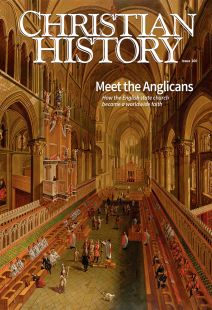
Questions for reflection: Anglicans


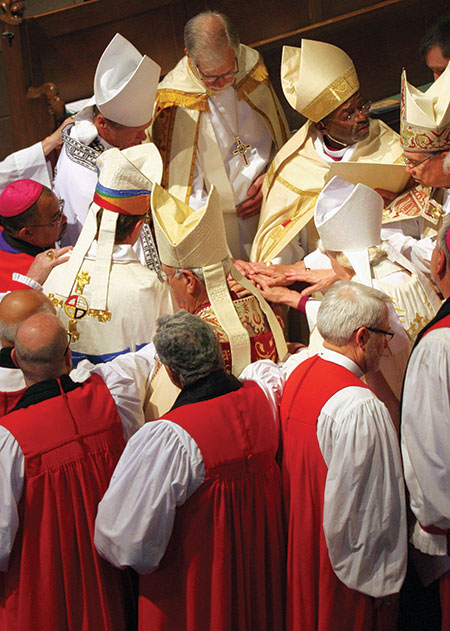
(ABOVE: Jonathan D. Thoreson (photographer), Bishops laying hands on Douglas Sparks, consecrating him the eighth bishop of the Episcopal Diocese of Northern Indiana, Trinity English Lutheran Church, Fort Wayne, IN, 25 June 2016—[GNU FDL] Wikimedia Commons)
1. What were some unfamiliar terms or ideas you encountered in “Did you know?” (See inside front cover.) What did you learn?
2. Who was Thomas Becket (pp. 6–9)? In what ways did the church and the monarchy begin to clash in the Middle Ages?
3. How did the Reformation in England (see pp. 11–13) look different from the Reformation in Europe, and why?
4. Consider the excerpts from The Anglican Tradition on page 10. How do these passages capture the radical changes the church endured during the reigns of Henry VIII and his children?
5. What caused the English Civil War during the seventeenth century (pp. 15–17)? What happened to the Church of England during this time?
6. Who were the members of the Clapham Sect (pp. 18–20)? What did their work accomplish?
7. What was the Oxford Movement (pp. 22–24)? How did John Henry Newman and others advocate for reform within the Church of England?
8. Why did the Episcopal Church in America form and organize separately from the Church of England (pp. 29–32)?
9. What was the broad church movement (p. 33)? How did it affect Anglicanism in the twentieth century in England and the United States?
10. How and why did missions to places such as Africa and South America shift to missions from these places (pp. 34–36)?
11. How did the faith of the Anglican writers on pages 37 to 39 influence their work? Were you surprised to learn any of these writers were Anglican? Why?
12. Why did C. S. Lewis reject the Anglicanism of his youth (p. 40)? What were some reasons for his return?
13. What do the figures on pages 41 through 44 have in common? How do their expressions of Anglicanism differ?
14. Consider the perspectives offered on Anglicanism in the interviews on pages 45 to 47. What did you learn? What surprised you about the interviewees’ spiritual journeys?
15. What events led to the formation of the Anglican Church of North America and its partnership with African Anglicans (p. 48)? How has African Anglicanism shaped the global Anglican community (p. 49)? CH
By the editors
[Christian History originally published this article in Christian History Issue #160.0 in 2026]
Next articles
“I am Cyrus”
Harry Truman’s support for the creation of the State of Israel was rooted in his interpretation of Scripture
Paul Charles Merkley
A Nation on a Mission
William McKinley saw America's unexpected opportunity in the Philippines as a sign from God—and set the U.S. on a new course of global influence
Richard V. Pierard
Civil Religion in America
Presidents have often served as chief pastors of the nation's shared beliefs
Gary Scott Smith
Hot Words in the Cold War
In his controversial "Evil Empire" speech, Ronald Reagan sought to re-moralize America's conflict with the Soviet Union
Paul Kengor