To the ends of the earth and back again


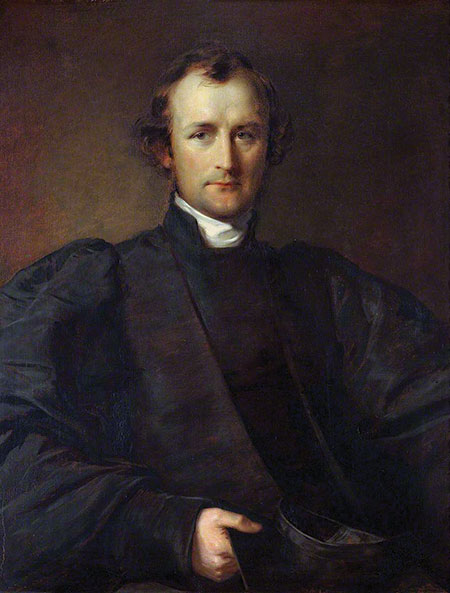
(ABOVE: George Richmond (painter), George Augustus Selwyn, Bishop of New Zealand and of Lichfield, 1855 (oil on canvas)—Selwyn College 21 / Public domain, Wikimedia Commons)
As his boat, the Southern Cross, cut through the winds and waves of the South Pacific in the late nineteenth century, John Coleridge Patteson (1827–1871) was a long way from the cultural comforts of England. The son of a knighted judge, equipped with multiple university degrees and a passion for languages, Patteson could have easily rooted himself in a safe parish ministry at home. Instead he was ordained a deacon in 1853 and, a year later, answered the call of Bishop George Selwyn to share the gospel in New Zealand and the South Pacific Islands. He gave up comfort and security to spend the rest of his life traversing 2,000 miles of ocean on the other side of the world.
Patteson, an exceptional linguist, had already studied German, Arabic, and Hebrew. His gifts for foreign languages truly flourished as he eventually mastered 23 Melanesian languages to better devote himself to serving the people of these diverse island communities. His respect and love for Christ and the indigenous people he served were evident in his striving to build Anglicanism locally in keeping with the indigenous cultural context. Eventually he would establish schools, teach students, and actively oppose the slave trade in the South Pacific.
In 1864 Patteson became the first missionary bishop of Melanesia, sailing to reach the various islands on his boat and working and living among the people he served. Then in 1871 Patteson visited Nukapu Island. The island had recently been subject to labor and slave raids, which Patteson had long advocated against. Some of the raiders may have painted their ship to match Patteson’s, and in a possible case of mistaken identity, Patteson and two of his companions were killed by those they came to serve in retaliation for native deaths at the hands of slave raiders. Remembered today as a martyr, Patteson built a strong foundation for the church, not only in the South Pacific, but in the Global South as a whole, as he sailed across the miles in the Southern Cross.
Anglicanism certainly spread as a part of British imperialism and colonialism, and benefited from plantations and slaves in the Caribbean in the eighteenth century. However, it also grew across the Global South and even journeyed back to the West due to the stories of people like Patteson, who poured themselves out for others, following the example of Jesus.
FREED TO EVANGELIZE
Patteson represents one face of Anglican mission, those leaving Britain for distant lands. Yet Anglicanism often took root through another pattern: indigenous Christians who transformed the church from within. Such a person, who exemplified both the effects of colonialism and the Anglican missionary zeal, was Samuel Ajayi Crowther (1809–1891).
Crowther, then called simply Ajayi, was born in what is modern-day Nigeria and left Africa in chains after being abducted by slave raiders and uprooted from his family and homeland at the tender age of 12. He watched as his home village was burned. As he was led away, his heart did not leave his people or his homeland. Despite being enslaved because of the imperial and colonial system, Crowther was raised to be an important indigenous missionary. Eventually he would return home with the Scripture translated into his native Yoruban tongue. The captive became an evangelist. The slave became a bishop. But that triumphant outcome was not apparent for many years yet.
Portuguese slave traders sold Crow-ther, and he found himself on a ship crossing the Atlantic. Crowther did not know to whom he would be sold next or where he would end up when the British Navy boarded his slave ship in April 1822 and came to his rescue. He and other freed slaves were taken to and settled in Sierra Leone, a country that William Wilberforce had helped establish as a colony for such cases (see pp. 18–20).
Though closer to home than before, Crowther experienced a way of life different from his upbringing. Formerly enslaved people from across inland Africa formed his new neighborhood, all carrying memories of the various lifestyles and traditions of their home countries. In Sierra Leone this cobbled community all lived and dressed according to a Western style.
Crowther spent the next several years under the care and tutelage of a British-based Anglican missionary organization, the Church Missionary Society, led by Reverend John Rahan. Rahan and the Church Missionary Society cared for and educated Crowther and many other freed people who had become Christians and had been resettled in Sierra Leone. In 1825 Crowther converted to Christianity and was baptized by Rahan. At this point he assumed the English name Samuel Crowther.
Fourah Bay College was established by the society in 1827 to train future Christian leaders, and Crowther studied and later taught there. There he formally learned English, Igbo, and several other inland African languages. He also had to relearn his native tongue of Yoruba after years away from home. He went on to translate the Bible and the Book of Common Prayer into Yoruba. In 1843 he was ordained a priest in the Church of England. Eventually he took the gospel throughout Western Africa to his homeland and up the Niger River, proving more resistant to the tropical diseases and the climate than the missionaries sent from Europe. In 1864 Crowther was named “Bishop of the countries of West Africa beyond the limits of our dominions,” the first indigenous African bishop in worldwide Anglicanism.
Racism struck again, however. Despite his accomplished and faithful ministry to West Africa, Crowther was not allowed to enjoy the fruits of this labors. After having done much to spread the faith in West Africa, as he got older, he saw younger European missionaries come in and dismantle his work, replacing indigenous workers with White Europeans and eventually forcing Crowther’s resignation.
The effects of colonialism and racism marked Crowther’s life, but so did the love of the gospel. Although it may have seemed, at the end of his life, that only vestiges of his work would remain, Crowther laid the foundation for the explosive growth of Christianity in West Africa. Crowther planted the seeds of Anglicanism in Nigeria that grew to a church of about 25 million members, a church as large as the Church of England itself.
HOME-GROWN ANGLICANISM
Over the years Anglican mission would no longer come solely from the West. The rise of organizations such as the Global Anglican Future Conference (GAFCON), established in 2008, have caused a shift in Anglican leadership and mission toward the Global South; missions would even originate from there. The church’s focus has become sharing the gospel from everywhere to everywhere, no longer just the countries of the West sending missionaries to the South or the rich educating the poor.
Today one example of this is the Anglican Church in Brazil–Diocese of Recife, which has worked to reach low-income neighborhoods and even planted a congregation on the beach. The Anglican Church in Brazil is now partnering to support and grow parishes in Central and South America. The church in Africa and South America has also sent missionaries to Europe and America to help revitalize churches in the post-Christian West, including partnering with Westerners to establish the Anglican Mission in the Americas (2000) and the Anglican Mission in England (2013). Africa, especially Crowther’s native Nigeria, has been instrumental in providing structural and theological support to the Anglican Church in North America (ACNA), forming the Convocation of Anglicans in North America (CANA) in 2005. CANA was a founding partner of the Anglican Church in North America when it was established in 2009.
Dispersal of Anglicanism across the globe is aided by not only an increasingly mobile society but also by Christians resettling from areas of war or persecution. A recent example has been the wars in Sudan, which have displaced Christians first to neighboring countries and then sometimes farther as they resettle. War-displaced Christians in Sudan have carried the gospel life and light into refugee settlements and cities farther abroad. In some ways this mirrors how the church spread in its earliest days—persecution and conflict forced Christians to flee and take the gospel with them.
While Anglicanism spread early in a traditional fashion from the United Kingdom and America, its missions have now shifted to a collaborative effort by the global church. The center of Anglicanism has shifted from England to countries such as Nigeria, Uganda, and Kenya, with other Global South churches assuming leadership roles. History shows us that faith and the gospel are not about hierarchy and economics, but about all people sharing the truth of Christ everywhere. The story of Anglican mission is not simply the story of the English missionary society sending evangelists abroad. It is the story of Christians from around the globe carrying the gospel across cultures, languages, and borders—even back to the lands that first sent missionaries to their country. CH
By Jonathan S. Riches
[Christian History originally published this article in Christian History Issue #160.0 in 2026]
Jonathan S. Riches teaches Bible and history at Phil-Mont Christian Academy and is a professor of theology, vicar, and canon theologian of the Anglican Church in North America.Next articles
No poet is an island
Some writers whose Anglican faith was central to their work
Karen Swallow Prior

Preaching, writing, caring, transforming
Faces of Anglicanism in the twenty-first century
Jennifer A. Boardman
The road from Canterbury
an Anglican roundtable discussion
Michael Matlock, Elise Johnstone, Matthew Barrett, Bruce Cory