Making England good again


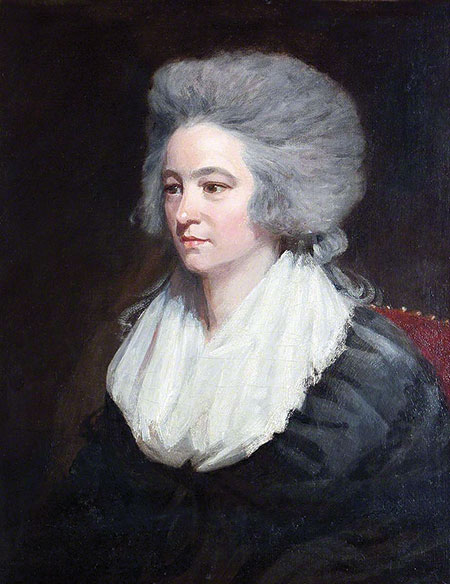
(ABOVE: John Opie (painter), Hannah More, 1786 (oil on canvas)—Girton College / Public domain, Wikimedia Commons)
Against our current culture—one in which more is better and numbers matter most—the Clapham Sect stands apart. This band of evangelical Anglican reformers, active in England from the 1790s to the 1830s, had only a few dozen members. Yet small as it was, as one historian has stated, it likely accomplished more than any similar coalition in English history.
The Clapham Sect is most known today for its greatest cause, the abolition of the British slave trade, and its most famous member, William Wilberforce (see CH #53). However, the group—also variously called the Clapham Saints, the Clapham Circle, the Clapham Party, and the Claphamites—tackled an array of reforms in a sweeping attempt “to make goodness fashionable,” as its collective effort is often described. Whatever success it had—and by any measure, it was considerable—owes to the group’s embrace of diverse personalities and gifts, shared vision, and commitment to embodied community.
Indeed, Clapham wasn’t just a project; it was a place.
GOOD NEIGHBORS
Clapham, now a district in the southwest of London, then an outlying village, was home to Holy Trinity Church (now Holy Trinity Clapham), where key members of the Clapham Sect worshiped. The rector of Holy Trinity, John Venn (1759–1813), was an evangelical preacher brought to Holy Trinity in 1792 by the influential and evangelical Thornton family. That same year Henry Thornton (1760–1815)—a prosperous banker, philanthropist, and leading abolitionist—bought Battersea Rise, a majestic home in Clapham where the people who would come to be known as the Clapham Sect gathered to encourage, inspire, strategize, and even reside at times. Clapham became home for many members of the group, helping their friends to sustain their shared vision and work through physical proximity, communal worship, and neighborliness.
Thornton’s cousin and close friend William Wilberforce (1759–1833) was among those who lived in Clapham. Wilberforce was a member of Parliament who advanced his efforts over many years to end the British slave trade through incremental legislation. Having entered Parliament in 1780 at age 21 while still a dissipated youth, Wilberforce came under spiritual conviction in 1785. He sought counsel from the famous former slave ship captain, John Newton (1725–1807), who had since become rector at St. Mary Woolnoth in London (see p. 21). Wilberforce assumed that becoming a committed Christian would require him to leave public service and enter the ministry. Newton, fortunately, convinced him otherwise.
In 1786 leading abolitionists sought out the newly converted Wilberforce, hoping to find in him an advocate for their cause in Parliament. They did. In 1787 Wilberforce wrote in his journal these now famous words: “God Almighty has set before me two great objects, the suppression of the slave trade and the reformation
of manners.”
The pursuit of these “two great objects”—the abolition of the British slave trade and moral reform across society—became the coalescing force of the Clapham Sect. That vision is often, and correctly, understood as a vision of social reform. Yet it can also be understood as the embodiment of the virtue of benevolence—literally, good will toward others—and the Clapham Sect sought to enact such goodwill to all, regardless of class, race, or creed.
Such a way of thinking was remarkable within what was still a rigidly stratified society. Numerous members of the Clapham Sect came to embrace such active benevolence through transformative experiences: moral awakenings that turned into spiritual awakenings.
MEET THE CLAPHAMITES
The name is a bit of a misnomer. The group’s members were committed communicants of the Church of England, so it was not a “sect” in the true sense. Rather members were among many Anglicans influenced by the evangelical revival sweeping across England and the transatlantic region during the eighteenth century. The evangelical movement transcended denominational divides and was based not on doctrinal or ecclesiastical distinctions but on renewed emphases.
Historian David Bebbington identifies these four emphases as conversionism, biblicism, crucicentrism (the centrality of Christ’s death on the cross), and activism. Clapham Sect members reflected the emphasis on the experience of conversion and the spirit of activism in particular. Often their transformative experiences entailed facing the slave trade’s horrors, followed by a recognition that it posed the greatest moral question of their time.
For example Zachary Macaulay (1768–1838) left a life of youthful rebellion to work on a sugar plantation in Jamaica where he saw the evils of slavery firsthand. His journals record horrific accounts of the cruelties he witnessed. Upon his return to London, he came under the influence of his brother-in-law Thomas Babington (1758–1837), an evangelical philanthropist, a member of Parliament, and a Claphamite. Babington reflected the array of social reforms that interested the group; he not only opposed slavery but also took up the causes of smallpox vaccinations and expanded voting rights.
Macaulay went on to serve as governor of Sierra Leone, which Thornton helped establish to resettle newly freed Africans (see pp. 34–36). He eventually settled in Clapham upon marrying a young woman he met teaching at one of the schools run by fellow Claphamite Hannah More (1745–1833). Macaulay opened an academy in Clapham devoted to educating boys from Sierra Leone. He also directly supported many of the missionary, evangelistic, and social reform efforts championed by other Claphamites and served as editor of the Christian Observer, an evangelical journal that voiced the views and concerns of the Clapham Sect.
James Stephen (1758–1832, great-grandfather of Virginia Woolf) was a lawyer and a member of Parliament who became an abolitionist after witnessing an enslaved African being burned alive. Stephen was the legal architect who drafted legislation that would eventually be passed by Parliament as the Slave Trade Act of 1807, thus bringing an end to the Atlantic slave trade within the British Empire. It would take more years and continued efforts to bring about emancipation.
GIFTED FOR GOOD
Members of the Clapham Sect understood that goodwill must be manifested in concrete actions over time. For those serving in public office, that meant political action. Those of financial means acted with monetary support. Those whose gifts were thinking, writing, teaching, or preaching used their powers to persuade their fellow citizens to stem evil and do good. They were diligent, patient, and determined.
Henry Thornton used his considerable resources to underwrite various projects of the Clapham Sect, including helping found the Sierra Leone Company and the Christian Observer. He also supported the organizations now known as the Christian Mission Society (CMS) and the Bible Society, along with numerous similar projects.
Other wealthy members of the Clapham Sect funded various evangelistic and educational efforts, including projects led by Hannah More. In More’s younger years, she was a rising star in literary and London social circles, but under the influence of Newton and other abolitionists, she became an evangelical Anglican and retreated from fashionable life.
Notably More was the only female member of the Clapham Sect who was not so by virtue of being a relative or spouse of one of the men. The breadth of More’s social reform efforts—opening Sunday schools whose purpose was to teach the children of laborers reading, arithmetic, and Bible lessons; producing cheap tracts containing domestic tips and moral tales for mass distribution; writing religious treatises for the upper and middle classes; and publishing antislavery poetry—well reflects the overarching reform vision of the Clapham circle.
Another writer in the group was Thomas Gisborne (1758–1846), an Anglican priest who penned an array of theological, philosophical, and poetical works. Some of these poems were set to music and sung as hymns. Like More he used his gift of writing to advocate the abolitionist cause, publishing in 1792 the treatise On Slavery and the Slave Trade.
Charles Grant (1746–1823), chairman of the British East India Company and a member of Parliament, lived in Clapham and supported a number of humanitarian and evangelistic causes as well as serving on the London Abolition Committee.
CLAPHAM’S LEGACY
As activists the Claphamites were reformers, not revolutionaries; they were largely conservative theologically, socially, and politically. They sought to suppress vices such as drunkenness, dueling, gambling, prostitution, and Sabbath-breaking. They adhered to conservative gender norms as well. Hannah More could not join the Society for Effecting the Abolition of the African Slave Trade because she was a woman, for example, and Wilberforce discouraged women from taking too public a role in the work, despite relying heavily on More’s contributions to the cause.
However, some of the Clapham efforts would not be considered “conservative” according to the use of the term today. The group advocated for the reform of prisons, labor laws, education, and voting. Wilberforce even helped to found the first Society for the Prevention of Cruelty to Animals.
The Claphamites’ holistic vision and broadminded ability to cross religious, political, and social aisles to cooperate with others who shared their vision made them a potent force for change. They worked with Quakers, Methodists, nonevangelical Anglicans, and others: first, to bring an end to the British slave trade, then, finally, to free enslaved people across the British Empire with the Emancipation Act of 1833. Because many of the societies and programs they founded and supported continue today, this small circle of like-minded neighbors has remained a mighty force for good. CH
By Karen Swallow Prior
[Christian History originally published this article in Christian History Issue #160.0 in 2026]
Karen Swallow Prior is the 2025–2026 Karlson Scholar at Bethel Seminary, a speaker, and author of numerous works, including Fierce Convictions: The Extraordinary Life of Hannah More.Next articles


“The sacred gift has been handed down”
Tracts for the Times was a series of 90 essays published between 1833 and 1841 by members of the Oxford Movement in the Church of England. Below are some excerpts that show their desire to move Anglican doctrine and practice closer to a Catholic model.
tractarians
Christian History Timeline: The story of Anglicanism
Highlights of events covered in this issue
the editors