Did you know? Anglicans


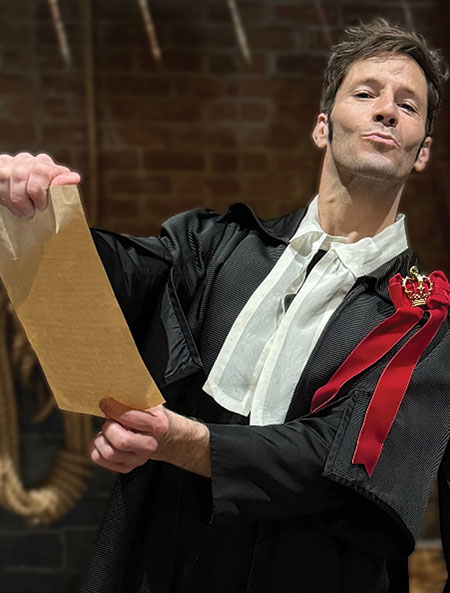
(ABOVE: Ali Beary (photographer), Thayne Jasperson in his Samuel Seabury costume, May 11, 2025—[CC0 1.0] Wikimedia Commons)
Let’s start at the very beginning….
The name “Anglican” means simply “relating to England or the English” (the word “England” means “land of the Angles,” i.e., Anglo-Saxons). Anglican denominations have their origin in the way Christianity was practiced in England, beginning all the way back to the days of Roman Britain (see pp. 6–9). According to the Venerable Bede in his history of Christianity, in the sixth century, Pope Gregory I saw an Anglo-Saxon boy in a Roman slave market and, on being told that he came from the place of the pagan “Angles,” exclaimed “Non Angli sed angeli” (not Angles but angels) and prepared to evangelize southern Britain.
…but quickly get much more complex!
Many Anglican denominations exist throughout the world today. In this issue we’ll mostly trace the English and American stories, particularly these groups:
■ Church of England (COE): This church originates with Henry VIII’s break with the papacy in 1534 (pp. 11–13, 14). It is the official state church of England, which the archbishop of Canterbury heads. Anglicanism in Scotland is expressed by the Scottish Episcopal Church (the state church of Scotland is Presbyterian) and in Wales by the Church in Wales (not a state church).
■ The Episcopal Church (ECUSA or TEC): This expression of American Anglicanism came to North America with British settlers and was formally organized (as the Protestant Episcopal Church in the USA) in 1789 (pp. 29–32).
■ Anglican Communion: This worldwide fellowship of Anglican denominations grew out of the Church of England in the eighteenth and nineteenth centuries (pp. 34–36). It has no official founding date but coalesced in the 1800s around the Lambeth Conference, an international meeting of Anglican bishops. The archbishop of Canterbury presides over Lambeth, which began in 1867 and has occurred every 10 years since 1878. Churches in this fellowship are said to be “in communion” with the archbishop of Canterbury.
■ Reformed Episcopal Church (REC): This group was founded in 1873 in New York City as a protest against the Episcopal Church’s nineteenth-century move toward more Catholic doctrine and practice (pp. 22–24). Today it is part of the Anglican Church in North America.
■ Continuing Churches: Theological debates from the 1960s led to the “continuing church movement” containing groups who opposed what they saw as a liberal drift in TEC and the Anglican Church of Canada and wanted to “continue” on a more conservative path. Among those that still exist today are the Anglican Catholic Church and the Anglican Province of Christ the King.
■ Anglican Mission in the Americas (AMiA): Connected to the continuing church movement, this group was officially founded in 2000 as a conservative mission in the United States under the supervision of bishops in Rwanda and Southeast Asia (pp. 48, 49).
■ Global Fellowship of Confessing Anglicans (GAFCON): This group of worldwide Anglican denominations was founded in 2008 as a conservative counterpart to the Anglican Communion, especially on issues of human sexuality.
■ Anglican Church of North America (ACNA): With roots in some earlier conservative protests, and as a direct response to the 2003 consecration of a practicing homosexual bishop by TEC, the ACNA was founded in 2009. The REC and AMiA were founding members, although AMiA later left. ACNA members often use the language of “three streams” to describe the denomination (Anglo-Catholic, Reformed, and charismatic; see pp. 22–24).
What to call Anglicans
■ Bishops, priests, and deacons: The Church of England retained the threefold organization of the ordained ministry that had characterized the Roman Catholic Church, while eliminating many of the minor orders of medieval Catholicism. A bishop oversees a diocese, including its clergy and parishes. (“Episcopal” means “having bishops.”) A bishop is the only one who can confirm members into the church, and he or she also provides other forms of spiritual and organizational leadership.
A priest is ordained to preside at the Eucharist and preach the gospel, while a deacon is ordained to proclaim the gospel through word and service—often in a way that primarily involves ministry in the “world”—and to assist bishops and priests. You may also hear the terms “vicar,” “curate,” and “rector.” Historically the rector was the priest in charge of a parish, and the vicar and curate were assistants.
■ Parish: Originally a parish included all people in a certain geographical area surrounding a church (whether or not they actually attended it). Today in many places “parish” is used interchangeably with “congregation.”
■ Vestry: A vestry is an elected group of laypeople who are in charge of the government of a parish. The COE no longer has vestries, but churches in the United States and elsewhere do.
■ Diocese: A diocese is the organization of parishes in a geographical area all under the supervision of one bishop, normally called a “bishop diocesan” or an “ordinary.”
■ Province: A province is a collection of dioceses.
■ Synod: A synod is a meeting held to govern the church. Today synods generally include lay, clergy, and episcopal representatives. CH
By Editors
[Christian History originally published this article in Christian History Issue #160.0 in 2026]
Next articles


The Anglicans: Senior editor's note
I was seeking a deeper connection with my Lord at his Supper.
Jennifer Woodruff Tait