No poet is an island


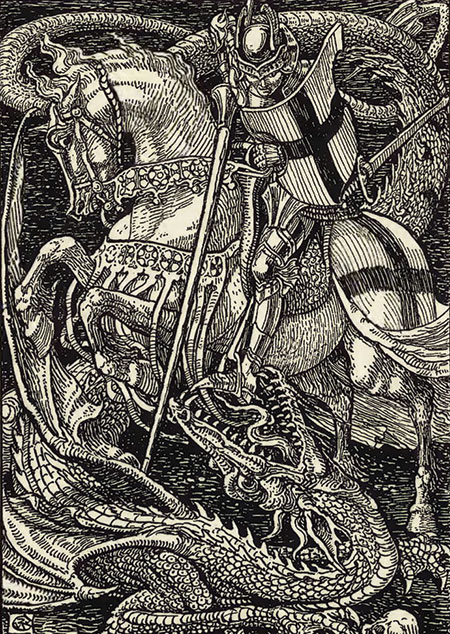
(ABOVE: Walter Crane, The Redcrosse Knight, from The art of Walter Crane, ed. P. G. Konody (London: G. Bell & sons, 1902), plate on p. 69—Public domain, Wikimedia Commons)
Despite popular conceptions the Anglican literary tradition is much deeper and wider than C. S. Lewis and some of his friends (see CH #113). Indeed it is long and rich, spanning five centuries—and counting—offering literature that has shaped both the Christian and the secular worlds.
ELOQUENT ELIZABETHANS
The “Golden Age” of English literature is set squarely within the Church of England’s establishment. Of course William Shakespeare (1564–1616), baptized into the Church of England as an infant, is the brightest luminary in this period of English literature, but he is hardly the sole star. Queen Elizabeth I (see pp. 11–13) was not only a patron of the literary arts but was a poet in her own right, a gifted letter-writer, and a rhetorician. Her writing played a crucial part within the delicate architecture by which Elizabeth served as “defender of the faith.”
One of the greatest poets of the Elizabethan age, Edmund Spenser (c. 1552–1599), celebrated the Anglican Church and Elizabeth, its supreme defender. His masterpiece from the 1590s, the allegorical epic poem The Faerie Queene, features knights that symbolize Christian virtues such as holiness, temperance, chastity, and justice; they battle dragons, giants, and other representations of human vice and doctrinal error. He portrays the Roman Catholic Church allegorically as an enemy to be defeated, and Queen Elizabeth is symbolized as the embodiment of Britain’s glory as both a nation and a church.
WITTY WORDSMITHING
In the seventeenth century, writerly experimentation, wit, and artistry flourished among its authors—including some of the best poets in the English language, whose literary excellence is inseparable from their churchmanship. Foremost among these is John Donne (1572–1631). Though Donne was born into a Roman Catholic family, he later joined the Church of England, was ordained as a priest in 1615, and eventually became dean of St. Paul’s Cathedral in London. Witty and erudite Donne tended in his earlier poetry toward the satirical and erotic but took a later turn toward the devotional, in parallel with his vocational, theological, and spiritual journey.
While most lauded for his poetry, Donne is perhaps best loved for one of his prose works, a meditation containing the famous line, “No man is an island.” Regardless of his subject matter, Donne displayed an unusual balance between passion and reason, a combination expressed powerfully in his metaphysical poetry.
The metaphysical school was a movement of seventeenth–century poets characterized by their use of unusual extended metaphors. These metaphysical conceits, as they are called, used ordinary physical objects to reveal eternal, transcendent spiritual truths. Donne’s friend and fellow Anglican clergyman George Herbert (1593–1633) was another of these poets. Herbert’s wit was more subtle but no less brilliant than Donne’s. His surviving body of poetry is entirely spiritual and devotional and is collected in a volume titled The Temple (1633), which consists of sections named for the architectural components of an Anglican church.
One such example of Herbert’s metaphysical conceits is “The Pulley,” a poem in which the human need for rest is compared to a pulley that pulls human beings back to God to find their rest in him. Herbert also wrote “emblem poems” (or shape poems), verses arranged with lines that resemble the subject—the shape of an altar in “The Altar,” for example, or of wings in “Easter Wings.”
SATIRICAL SCRIBES
By the eighteenth century, the British nation and the Church of England were prominent and powerful, claiming an identity that echoed the reign of the classical Roman emperor Augustus. The corresponding literary era became known as the Augustan age (or the Neoclassical period). Many of this era’s prominent writers were devout Anglicans but often rendered their faith commitments more implicitly than explicitly. Furthermore, conditions were ripe for a literary mode that often thrives in a homogenous culture with shared theological conviction: satire. The Anglican writers who wrote using this literary mode—which mocks vice or folly for the purpose of correction—expressed, paradoxically, their earnestness through a posture of irony and mockery.
Widely considered the best satirist in the English language, Anglican clergyman Jonathan Swift (1667–1745) served as dean of St. Patrick’s Cathedral in Dublin from 1713 until his death. Steeped in Christian theology and Anglicanism, which he viewed as the virtuous via media between doctrinal and ecclesiastical extremes, Swift wielded satire to critique a multitude of individual and social sins. But pride was the vice Swift judged to be the besetting sin of his age. Pride in human progress, ethnocentrism, and chronological snobbery were all objects for Swift’s barbed wit, brilliantly on display in Gulliver’s Travels (1726) and A Modest Proposal (1729).
Laurence Sterne (1713–1768), ordained a priest in the Church of England in 1738 and later a major innovator of the novel, also began his writing career with satire. He produced satirical pamphlets in the midst of an ecclesiastical debate. The debate ended poorly, but the experience allowed Sterne to discover his gift for writing, particularly in the comic mode. His masterpiece, The Life and Opinions of Tristram Shandy; Gentleman (published in parts from 1759 to 1767) has been described as the first postmodern novel because of its nonlinear structure, word play, and narrative self-consciousness.
Tristram Shandy was groundbreaking in literary terms, garnering acclaim and criticism, the latter primarily regarding a level of bawdiness that brought Sterne rebuke from at least one bishop. Sterne’s sermons and later work reveal him to be cutting edge in other ways too. He anticipated the later sentimental movement in literature and sympathized with early antislavery views.
ROMANTICS AND REALISTS
The Romantic movement replaced the early eighteenth century’s satirical spirit by the century’s end. Samuel Taylor Coleridge (1772–1834) gave voice to the Romantic movement through his poetry and his philosophical works. The son of an Anglican vicar, raised in the Church of England, Coleridge strayed from orthodox beliefs for a time, but returned to the Church of England later in life. Always, however, his works expressed deep and profound theological understanding—of human nature, human language, and the way both of these reflect God’s nature and the nature of his image-bearers.
Developing a synthesis between opposing impulses of satire and Romantic sensibility, Jane Austen (1775–1817) offered the best of both ways of looking at the world. The daughter of an Anglican clergyman and herself a devoted member of the Church of England, Austen wrote novels that followed in the tradition of the comedy of manners, and in so doing, her works established newly respectable ground for the novel as a literary genre. Steeped in classical Christian virtues, Austen’s novels reflect the regularity of the Anglican liturgy and the dialogical nature of the Book of Common Prayer.
By the nineteenth century, the Church of England faced internal and external pressures. The Brontë sisters, Charlotte (1816–1855), Emily (1818–1848), and Anne (1820–1849), reflected these tensions in their collected works. The Brontës, daughters of an Anglican clergyman, had grown up in the church. The most literarily acclaimed of the sisters is Charlotte, whose Jane Eyre (1847) notably critiques hypocrisies of nominal faith and the corrupt Christian institutions that plagued the Victorian era. Shirley (1849), a lesser-known novel by Charlotte, wrestles directly with rising tensions in the Anglican Church between high and low church traditions within the context of the Industrial Revolution.
Christina Rossetti (1830–1894) is most known for her poetry, which ranges from fantastical to emotional to devotional, often experimental, but visionary and splendidly crafted. Her most beloved devotional poem, “In the Bleak Midwinter” (1872), has been set to music and sung over the years by chamber singers and pop stars alike. Rossetti, deeply committed to her Anglican faith, turned down two offers of marriage over the course of her lifetime owing to both suitors’ incompatible religious beliefs. She remained single, channeling her passionate energies toward social change: ministering to former prostitutes, aiding the Society for Promoting Christian Knowledge, and advocating against war, slavery, and animal cruelty.
MANAGING MODERNITY
Anglicans writing in the modern period found themselves in a faith context of increasing skepticism and even hostility. Hence hints of an apologetic mode began to emerge in their works. This context makes T. S. Eliot (1888–1965) one of the most interesting Anglican writers of this period. A highly regarded poet and critic of the modernist movement, Eliot was an adult convert to Anglicanism. His masterpiece, The Waste Land, is one of the most important works of poetry of the twentieth century. Published in 1922, a few years before Eliot was received into the Church of England in 1927 (he was once a Unitarian), the poem achingly searches for meaning, suggesting a hunger for faith that Eliot would soon satisfy by converting to Anglicanism.
Perhaps Anglicanism’s most prolific and multifaceted writer is Dorothy L. Sayers (1893–1957). Sayers wrote detective fiction, radio dramas, stage plays, poetry, literary and cultural criticism, and religious works. Are Women Human? (1938) and Why Work? (1942) offer robust theological insights into matters that were both timely and timeless for the church. In addition Sayers’s translation of Dante’s Divine Comedy—a years’ long undertaking left unfinished at her death—remains widely acclaimed today for its poetic quality and its readability.
Sayers was a friend of C. S. Lewis (1898–1963), who also wrote in many genres (see p. 40). Their literary relationship was mutually influential in fruitful ways that have helped continue their legacies—legacies that were themselves centuries in the making and, in turn, continue the long, rich tradition of Anglican literature. CH
By Karen Swallow Prior
[Christian History originally published this article in Christian History Issue #160.0 in 2026]
Karen Swallow Prior is a scholar, speaker, and author.Next articles

Preaching, writing, caring, transforming
Faces of Anglicanism in the twenty-first century
Jennifer A. Boardman
The road from Canterbury
an Anglican roundtable discussion
Michael Matlock, Elise Johnstone, Matthew Barrett, Bruce Cory