The holy Lamb on “mountains green”


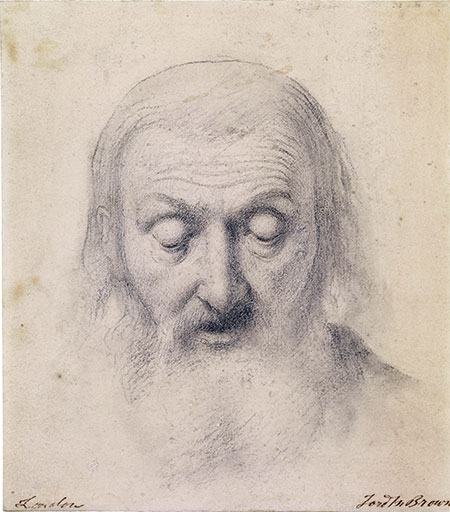
(ABOVE: Ford Madox Brown (artist), Wycliffe Reading his Translation of the Bible (Study for the Head of Wycliffe), 1847 (pencil on paper)—Birmingham Museum & Art Gallery / Public domain, Wikimedia Commons)
How early did Christianity come to Britain? If we give credence to the legend once set forth in song by William Blake (1757–1827), very early indeed:
And did those feet in ancient time,
Walk upon England’s mountains green:
And was the holy Lamb of God,
On England’s pleasant pastures seen!
Medieval legends from the twelfth century on held that Joseph of Arimathea traveled to Britain as early as AD 36 and later founded a church at Glastonbury. Others gave credit to Simon Zelotes, Aristobulus, and even Paul the Apostle for exposing early Britons to the Christian faith. Modern historians doubt these accounts and generally agree that Christianity arrived in England with the Roman Empire.
During the reign of Claudius (AD 41–54), armies under Aulus Plautius began Rome’s conquest of Britain. When he retired in 47, the empire controlled much of southeastern Britain. The Eastern Orthodox tradition maintains that Aristobulus arrived as a missionary in the wake of these conquests. He was a Jewish Cypriot who converted to Christianity and is thought to have been one of the 70 disciples mentioned in the Gospel of Luke. The Orthodox tradition describes his journey as culminating with an appointment as first bishop of Britain.
A different tradition from within Roman Catholicism cites a letter to Eleutherius (pope, c. 171–189) from Lucius, an unverified king of the Britons in the late second century, which asked the pope how he might become a Christian. As with the accounts of Joseph of Arimathea, historians have found scant evidence for these early beginnings. However, Tertullian and Origen attest to Christianity existing in Britain in writings dated from the early third century.
Regardless of how it arrived, by the turn of the fourth century, Christianity was well established in Britain. Reliable accounts of this period relate how Alban, later canonized, sheltered a Christian priest in his home north of London during the Diocletian persecutions (303–311). The priest left such an impression on Alban that he converted to Christianity. When discovered, Alban was martyred, supposedly declaring, “I worship and adore the true and living God who created all things.” A few years later, bishops from Britain attended the Council of Arles, called by Constantine to resolve issues related to the Edict of Milan.
UNCONQUERED FAITH
Three centuries of Roman occupation encouraged Celtic Britons to adopt Latin customs and the Christian faith. People of the ancient Celtic fringe in present-day Wales, Scotland, and Ireland, mostly left to their own devices, resisted these pressures. After the sack of Rome in 410, Roman Britain became vulnerable to waves of invading Angles and Saxons. These Germanic tribes brought their version of paganism to Britain and established a set of independent kingdoms stretching from Kent in the southeast to Wessex in the west to Northumbria in the north of present-day England.
Latin Christianity waned within the dominion of the Anglo-Saxons, but a residual Christianity persisted among Britons left unconquered, mostly in the far west of Britain and Wales. This version of the faith is now known as Celtic Christianity, a designation that implies a kind of regional and theological unity that scholars believe never really existed. Nevertheless, Patricius (Patrick), born c. 389 in Roman Britain, was taken captive in a raid at age 16 and kept in Ireland as a slave for at least six years. He escaped and traveled for several years, then went home to Britain. There he received a vision to return and evangelize Ireland.
Patrick went to France to receive ecclesiastical training and consecration as a bishop. By the late fifth century, Patrick’s work in Ireland, combined with earlier missionary efforts by Palladius, had borne fruit with a multitude of converts and a network of growing churches. In 563 the Christian community in Ireland sent the abbot Columba to Iona, an island in the Inner Hebrides. There Columba established a monastery aimed at converting the Scoti, the Latin name for pagan Celts living beyond the northern pale of Roman Britain. Iona would later be called the “Cradle of Christianity” for its role in introducing the faith to Scotland.
Oswald, eventually king of Anglo-Saxon Northumbria, received asylum on Iona after his father’s death, and there he converted to Christianity. He returned home, assumed his throne, and facilitated the move of Irish monk Aidan from Iona to the island of Lindisfarne, later known as “Holy Island.” There Aidan built the Lindisfarne Priory, from which he made frequent excursions into Northumbria and introduced many of Oswald’s Anglo-Saxon barons to the Christian faith. A prayer attributed to him begins
Leave me alone with God as much as may be. As the tide draws the waters close in upon the shore, make me an island, set apart, alone with You, God, holy to You.
CORRALLING CELTIC CHRISTIANS
The Celtic variant of Christianity in Ireland, Wales, Scotland, and Northumbria soon drew the attention of Pope Gregory I, the Great (pope, 590–604). From Rome, Gregory came to regard the Christians in the British Isles as beyond his ecclesiastical authority and thus growing away from orthodoxy. In 596 Gregory sent Augustine (died c. 604), prior of a monastery in Rome (not to be confused with Augustine of Hippo), along with a company of men, on the “Gregorian mission” to convert pagan Anglo-Saxons in England to Christianity.
Augustine was welcomed in Kent by King Ethelbert (560–616) and his Frankish Christian wife, Bertha. Ethelbert allowed Augustine to use a church in Canterbury named for Martin of Tours. After converting Ethelbert, Augustine traveled to Arles in France and was consecrated the first archbishop of Canterbury. He received authority to consecrate 12 other bishops in England, including an archbishop for York who also had authority to consecrate 12 bishops. Augustine also ordained Laurence, a member of his mission, to be his successor at Canterbury.
However, Augustine could not secure submission of the existing bishops in Britain to Roman authority. A rift opened between Celtic Christianity in England and Roman Catholicism as pre-Gregorian bishops and their successors continued to follow the spiritual and liturgical lead of Irish clerics at Iona. The spread of Roman Catholic adherence among the Anglo-Saxons would have to wait until Theodore of Tarsus became archbishop of Canterbury. He served from 668 to 690, a 22-year term of service that largely brought Christianity in England under papal authority in Rome.
In the sixth and seventh centuries, pastoral care came from minsters; these were an array of cathedral chapters and monasteries chartered by kings and thegns (feudal lords) with grants of land and other rights. Monks and priests performed the sacraments among laity within range of their minsters, and the minsters became hubs of local and regional religious life.
But Christianity’s further spread was stymied after 793, when a series of Norse invasions began with an attack on Lindisfarne Priory. Churches and monasteries throughout the British Isles were plundered and destroyed, and along with them vital accounts of the church’s early history. Many of the Norsemen—mostly Danish—made Christianity their faith, but many did not. In time key figures like Dunstan, archbishop of Canterbury, and Oswald, archbishop of York, led a tenth-century revitalization of the monasteries, which in turn re-energized the laity. In 1066 Pope Alexander II supported William of Normandy’s invasion of England, lending a papal banner for the conqueror to carry into battles against Anglo-Saxon and Danish forces.
The Norman Conquest set Christianity in England on a new path of development. Once in control King William I determined to replace existing abbots and bishops with men of his own choosing, which had the effect of bringing English liturgical practices more in line with Normandy and the rest of France. By appointing his own people, he carefully preserved some ecclesiastical autonomy from Rome.
Lanfranc (1005–1089), William’s choice for archbishop of Canterbury, was highly respected within the church hierarchy and at the same time an advocate for William’s discretion in the appointment of high-ranking church officials, or “lay investiture.” (Lanfranc regularly corresponded with Margaret, queen of the Scots and a Christian, writing to her at one point, “Let there be a mutual exchange between us of prayers and good works. Those that I render are small indeed; but I am confident that I shall receive far greater benefits in return.”) Lanfranc sought to make his office superior to the archbishopric of York while also seeking to rid the church of vice and corruption.
Major monasteries at Lindisfarne, Muchelney, Tyne-mouth, and Whitby were reconstituted, and new ones such as Battle Abbey were built. In following years foundations were laid for Winchester Cathedral (1079), York Minster (1080), and Durham Cathedral (1093). In these institutions monastic orders such as the Cistercians and the Benedictines grew, and in 1131 England birthed its own order—the Gilbertines—founded by Gilbert of Sempringham.
In the tenth and eleventh centuries, dioceses and parishes with individual churches and chapels grew alongside the existing minster system. Rectors, vicars, and chaplains administering the sacraments in their parish churches eventually became a familiar sight throughout the English countryside. Christians expressed piety through participation in the sacraments, but also through prayers, observance of saints’ days, religious festivals, pilgrimages, veneration of images and relics, and displaying religious iconography.
ANSELM AND ANARCHY
The reigns of William I’s successors, William II (r. 1087–1100) and Henry I (r. 1100–1135) were noteworthy for the service of Anselm as archbishop of Canterbury. An early scholastic philosopher, Anselm (c. 1033–1109) wrote Proslogion (c. 1078). He pressed for greater control over ecclesiastical affairs, including restriction of lay investiture, and for the Gregorian Reform, which imposed a high standard of moral conduct on the clergy. Both kings forced Anselm to seek asylum in Europe amid conflicts over his authority.
In some ways Anselm succeeded in establishing the primacy of his office over the English church and in maintaining the power of the church in public affairs. However, after Henry I’s death, the nation entered a period of political chaos and civil war amid a clash over the royal succession. The era known as the Anarchy (1138–1153) produced widespread lawlessness. A great number of clergy became licentious and immoral. Of these times the Peterborough Chronicle observed that many people in England “said openly that Christ and his saints were asleep.”
Following the Anarchy, Henry II established the Constitutions of Clarendon (1164), which were intended to bring law-breaking clergy to justice by means of civil courts rather than in-house ecclesiastical discipline. The issue opened the question of the church’s rights and privileges; Archbishop Thomas Becket (1118–1170) refused to sign and was forced into exile. From a distance Henry II and Becket exchanged threatening royal edicts and warnings of excommunication, but a compromise brought Becket back to England. He then excommunicated three bishops who consecrated Henry II’s heir in violation of the privilege of his office. Four of Henry II’s knights responded by stabbing Becket to death in Canterbury Cathedral—supposedly after overhearing Henry say, “Will no one rid me of this turbulent priest?”
When Pope Alexander III declared Becket a saint and threatened an interdict over England, Henry II submitted to the rite of penance and was whipped by some 80 monks at Becket’s tomb. These events increased the power and prestige of the church in England, an outcome confirmed by Pope Innocent III’s six-year interdict over England from 1208 to 1214 due to King John’s refusal to seat Stephen Langton as archbishop of Canterbury. The interdict meant that marriages, burials, and other sacraments ceased across the entire land. Ultimately John relented and submitted to Langton’s consecration. The archbishop went on to draft the Magna Carta (1215), an agreement between John and his barons confirming the rights of the feudal nobility.
SCHOLASTICS AND LOLLARDS
Cambridge University was founded in 1209 during John’s troubled reign. This coincided with the arrival of the mendicant (begging) orders to England beginning with Dominicans (1221), Franciscans (1224), and Carmelites (1242). These orders stressed education. Franciscan priest Roger Bacon wrote and taught at Oxford University (founded c. 1096) and became a catalyst for scholasticism, a movement that rigorously pursued knowledge through dialectical reasoning, partly in an attempt to reconcile Christian theology with classical Greek and Roman philosophy.
Scholasticism influenced John Wycliffe (c. 1328–1384), who graduated from Merton College, served briefly as master of Balliol College, then became head of Canterbury Hall, all at Oxford University. He became rector at a nearby parish church and finished his doctorate, then began the work of translating the Latin Vulgate Bible into Middle English. Begun in 1372, his vernacular language New Testament was finished before his death in 1384; his associates continued to improve it and add an Old Testament translation.
Wycliffe’s Bible was a revolution in the making. Few English Christians were literate, but poring over Scripture brought Wycliffe and those in his circle to question not only certain Roman Catholic teachings and practices, but also the Roman curia as the ultimate source of truth. Wycliffe wrote books and tracts against clerical landowning, ecclesiastical imprisonment, and transubstantiation. This led Pope Gregory XI (r. 1370–1378) to issue bulls condemning his teachings (1377) and the Council of Constance (1415) to posthumously declare him a heretic.
Church officials burned Wycliffe’s writings—and his remains as well—but they couldn’t extinguish the movement he created. The Lollards, Wycliffe’s clerical followers, promoted the Bible as the highest authority and rule of faith and condemned “signs, rites, bishops’ blessings,” and other beliefs and rituals as being “nowhere ensampled in the Holy Scripture.” In 1395 the Lollards delivered their Twelve Conclusions to Parliament and posted it to the doors of Westminster Abbey and St. Paul’s Cathedral. That gesture heralded the eventual arrival of the Protestant Reformation and the transformation of English Catholicism into something new. CH
By Jeffrey B. Webb
[Christian History originally published this article in Christian History Issue #160.0 in 2026]
Jeffrey B. Webb is professor and department chair of history and political science at Huntington University.Next articles