Preaching, writing, caring, transforming


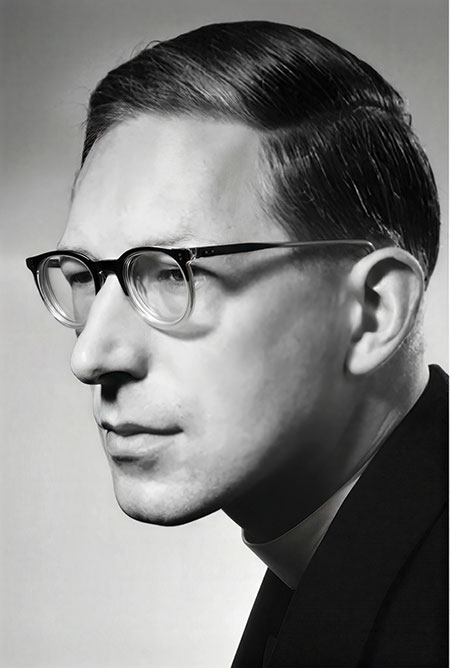
(ABOVE: J. I. Packer—Used by kind permission of the John Richard Allison Library, Regent College)
JOHN STOTT (1921–2011)
Born in London to Sir Arnold and Lady Emily “Lily” Scott, John Stott grew up in the Church of England (COE). In 1935 he began attending boarding school at Rugby School, where he described himself as “estranged” from God. This changed at the school’s Christian Union, where Stott heard a talk by Anglican evangelist Eric Nash (1898–1982) on the question “What then shall I do with Jesus, who is called the Christ?” For the next five years, Nash answered Stott’s questions and mentored him, culminating in Stott deciding to study theology at Cambridge. While at Cambridge he wrote and began teaching at All Souls Church, where he worshiped as a child. He was ordained deacon in the COE in 1945 and priest in 1946, served as a curate, and then became the rector of All Souls, Langham Place, in 1950 at the age of 28.
Stott soon rolled up his sleeves. As his biographer Timothy Dudley-Smith wrote, “John Stott has provided a model for international city-center contemporary ministry now so widely accepted that few now realize its original innovative nature.” Among other innovations he created evangelism-training classes for his congregants, discipleship courses, lunchtime services, homeless ministries, and children and family services. He helped create the London Institute for Contemporary Christianity to form more bridges between Christian faith and intellectual reasoning.
Stott also helped advance the gospel in the developing world by training pastors and providing theological and biblical resources to church leaders. His book Basic Christianity is available in more than 3,000 languages. He died at age 90 and was buried in Dale, Pembrokeshire, Wales, where his gravestone reads: “Who resolved both as the grounds of his salvation and as the subject of his ministry to know nothing except Jesus Christ and him crucified” (1 Cor. 2:2).
J. I. PACKER (1926–2020)
James Innell Packer was raised in a middle-class, nominally Anglican home in Gloucestershire, England. He was confirmed at the age of 14, but he decided to follow Jesus when, as a student at Corpus Christi College, Oxford University, he heard a talk at the Oxford Inter-Collegiate Christian Union. He also heard lectures by then-professor C. S. Lewis. Packer was ordained as a priest in the COE in 1953 and earned his doctor of philosophy degree in 1954 at Wycliffe Hall, Oxford.
Packer was a prolific author, and his most famous book, Knowing God, was published in 1973. He wrote of his bestseller, “The conviction behind the book is that ignorance of God lies at the root of much of the church’s weakness today.” In 1954 Packer married Kit Mullet; they had three children. He and his family moved in 1979 to Vancouver, Canada, where Packer began his long teaching career at Regent College. He also served as general editor of the English Standard Version of the Bible and supported the Protestant-Catholic ecumenical movement for the greater advancement of the gospel.
Packer’s view of Anglicanism stressed the reliability of the Bible, the importance of praying to the triune God, and the essential call to make disciples and live holy lives. Instead of just thinking about God and talking about God—which he believed many modern evangelicals spent most of their time doing—Packer insisted that Christians needed to know God by spending time with him in prayer, by listening, and by studying the Bible. Packer died at the age of 93 in Vancouver.
FLEMING RUTLEDGE (b. 1937)
Hailing from Richmond, Virginia, Alice Fleming Parker (Rutledge) received her master of divinity degree from Union Theological Seminary in 1975. In 1977 Rutledge became one of the first female priests ordained in the Episcopal Church (TEC). After pastoring high schoolers at Christ Church, Rye, in New York—one of the oldest congregations in the United States—Rutledge served as senior associate priest at Grace Church in New York City. She has taught at Princeton, Wycliffe College at the University of Toronto, and the American Academy in Rome. Rutledge is also a noted Tolkien scholar and known for her evangelistic preaching. She married Reginald “Dick” Rutledge in 1959.
In 2015 Rutledge published one of her many books, The Crucifixion: Understanding the Death of Jesus Christ. In a recent interview, she discussed the immense cruelty of this particular Roman form of torture:
Crucified people disappeared. That was the purpose of crucifixion—to annihilate them, to erase them from the human record with the most degrading mode of public ‘disappearing’ someone that has ever been imagined. And I mean that almost as literally as I can. The cross and Resurrection are one event—you can’t have one without the other. If Jesus had not been raised from the dead, we never would have heard of Him.
N. T. WRIGHT (b. 1948)
As a boy living in Northumberland, an English county on the border of Scotland, Nicholas Thomas Wright recalls “sitting by myself . . . and being completely overcome, coming to tears, by the fact that God loved me so much he died for me. Everything that has happened to me since has produced wave upon wave of the same.” Wright was educated at Exeter College, Oxford, serving as president of the Oxford Inter-Collegiate Christian Union. He studied for the Anglican ministry at Wycliffe Hall, Oxford, and later received his doctor of divinity. He married Maggie Fiske in 1971, and they have four children.
Wright served in numerous positions as a Fellow, chaplain, professor, and lecturer at universities and colleges in England and Scotland; he also was canon theologian at Westminster Abbey in 2000 and bishop of Durham from 2003 to 2010. A prolific author, Wright has been a scholar of the “New Perspective” on Paul, which advocates studying the apostle Paul’s words in a first-century context instead of imposing modern norms on his writings. Wright also critiqued what he calls a very Western, American notion of heaven. He said in an interview, “The problem is that most Western Christians today think that the whole point of Christianity is for our souls to go to heaven when we die, whereas the New Testament concentrates on God coming to dwell with us.” To that end Wright encourages Christians to emphasize that not only did Jesus die and was resurrected, but that God has already begun forming a new creation.
ROWAN WILLIAMS (b. 1950)
Rowan Williams attended Christ’s College, Cambridge, to study theology. He received his doctor of philosophy degree from Wadham College, Oxford, in 1975 and was ordained as a priest in the COE in 1978. He married theologian Jane Paul in 1981, and they have two children.
Williams served as a lecturer, dean, chaplain, professor, and canon at both Cambridge and Oxford. In 1991 he was elected bishop of Monmouth in the Church in Wales and archbishop of Wales in 1999. Then in 2002 Williams was elected archbishop of Canterbury. He served until 2012.
In the 2010 General Synod of the COE, Williams condemned the infighting over female bishops and the ordination of practicing homosexuals, causing many conservative Anglicans to distrust his leadership. In 2008 the Indian canon Vinay Samuel (b. 1942), a member of the Global Anglican Future Conference (GAFCON) team, accused Williams of intellectual colonialism.
Following his term as archbishop, Williams went on to serve as master at Magdalene College, Cambridge, until 2020. In 2024 Williams was asked about the biggest challenge in the global church today, and he responded:
We’re divided perhaps more than we’ve been for a long time of how we use the Bible . . . as if the Bible has to be in every respect a 100% accurate guide to everything you can imagine from history to biology rather than the dependable communication from God of who God is.
SARAH COAKLEY (b. 1951)
Sarah Anne Furber (Coakley), of Blackheath, London, earned her graduate-level degrees at Harvard Divinity School and the University of Cambridge. She spent her career as a systematic theology professor at Lancaster, Oxford, Harvard, Princeton, and Cambridge Universities.At the latter school, she was appointed the Norris-Hulse Professor of Divinity, the first woman to hold the position. Furber was also ordained as a priest in the COE in 2001. She married James Coakley in 1975. They have two children.
Coakley’s academic and theological pursuits have centered around natural theology, including working with mathematicians and scientists and writing on Christology, the theology of the body, and Gregory of Nyssa.
In 2025, when asked to explain Christology, she responded,
It’s not that there was once this very nice bloke whom a few years later people decided to bump up to the level of divinity because there seemed to be enough qualifications. That’s a kind of extrinsic Batman approach to Christology, which is absolutely deadly. It only makes sense if the whole cosmos is transformed by it. It only makes sense if my moral life is changed by it. It only makes sense if the whole way I look at the universe and its beauty is affected by it.
ALISTER MCGRATH (b. 1953)
Born and raised in Northern Ireland, Alister McGrath was a talented science student at Oxford University, eventually earning his doctor of philosophy degree for his research in molecular biophysics in 1977. At the same time, however, McGrath was also fascinated by theology and later reflected that while at Oxford, “I was discovering that Christianity was far more intellectually robust than I had ever imagined.”
McGrath moved to Cambridge to study for ordination and was ordained a priest in the COE in 1981. He has held lecture and research positions at various academic institutions, including Oxford, Drew University, Regent College, and King’s College London.
When he was a teenager, McGrath had become an atheist. However, when he arrived at Oxford, he began having conversations with Christian students and reflected,
I had no idea that it was really about a personal relationship with Christ. Discovering that changed things in a very big way. I discovered not simply that Christianity was true, but also that it was real. It was not just something that made sense, but also something that could transform someone’s life.
McGrath’s personal story as both scientist and theologian as well as a former atheist made him a keen debater against prominent atheists after his conversion. Calling Richard Dawkins “embarrassingly ignorant of Christian theology,” McGrath debated the scientist as well as other prominent atheists. McGrath maintains a belief that science (including evolution) and Christianity complement each other, asserting, “Science does not in principle exclude God. Science simply says we are not going to bring God into things.”
MICHAEL CURRY (b. 1953)
Though Michael Curry’s parents were raised Baptist, they became Episcopalians after being served the same Communion chalice as White people in an Episcopal church in then-segregated Ohio. Curry earned his master of divinity degree from Yale University in 1978. He served as deacon, priest, and rector in churches in New York, North Carolina, Ohio, and Maryland, where he built ministries focusing on pastoral care, children’s education and care, preaching, and inner-city outreach. He and his wife, Sharon Clement Curry, have two children.
In 2000 Curry was elected eleventh bishop of the Episcopal Diocese of North Carolina, the first Black Episcopal bishop in the US South. He was then elected the first Black presiding bishop of TEC from 2015 to 2024. In 2016 Curry traveled to Canterbury Cathedral for a meeting of the heads of the global Anglican Communion. While he was there TEC was officially sanctioned for three years due to its stance on marrying same-sex partners. In response Curry stated: “
Our commitment to be an inclusive church is not based on a social theory or capitulation to the ways of the culture, but on our belief that the outstretched arms of Jesus on the cross are a sign of the very love of God reaching out to us all.
Known for his dynamic preaching, Curry officiated the wedding of Prince Harry and Meghan Markle in 2018, as well as the funerals of both Senator John McCain and former president George H. W. Bush. After stepping down as presiding bishop in 2024, he now sees his role as that of a Barnabas, a “son of encouragement” for the church. He says of the modern church’s role, “Not only our churches must be a house of prayer for all people, but our world must be a house for all people.”
SARAH MULLALLY (b. 1962)
Sarah Elisabeth Bowser (Mullally) became a Christian as a teen in Surrey, England. She chose to go into the medical field, opting for being a nurse rather than a doctor because it allowed her to care more holistically for her patients. In 1992 she received her master of science degree from London South Bank University. She married Eamonn Mullally in 1987, and they have two children.
Mullally held numerous nursing and leadership positions. In 1998 Mullally felt called to the church and began theological training, becoming a deacon in the Church of England in 2001 and a priest in 2002. She left nursing to pursue full-time ordained ministry in 2004. She served as the bishop of Crediton and London before succeeding Justin Welby as the archbishop of Canterbury in 2026. Mullally was the first woman elected to this highest position in the worldwide Anglican Communion.
Conservative Anglican groups, especially in Africa and the Global South, largely opposed her appointment to the post, due in part to their opposition to the ordination of women as well as Mullally’s support of the LGBTQ community. When asked about LGBTQ people in the church, Mullally said in 2018, “What we have to remember is this is about people, and the church seeks to demonstrate love to all, because it reflects the God of love, who loves everybody.” Mullally upholds the COE’s position that marriage is between one man and one woman, but she conducts blessings of same-sex couples in committed relationships. CH
By Jennifer A. Boardman
[Christian History originally published this article in Christian History Issue #160.0 in 2026]
Jennifer A. Boardman is a copyeditor and writer. She holds a master of theological studies from Bethel Seminary with a concentration in Christian history.Next articles
The road from Canterbury
an Anglican roundtable discussion
Michael Matlock, Elise Johnstone, Matthew Barrett, Bruce Cory


Recommended resources: Anglicans
Discover the history of the Anglicans—in England, the United States, and worldwide—with these resources recommended by our editors and authors.
the editoris