Religious whiplash


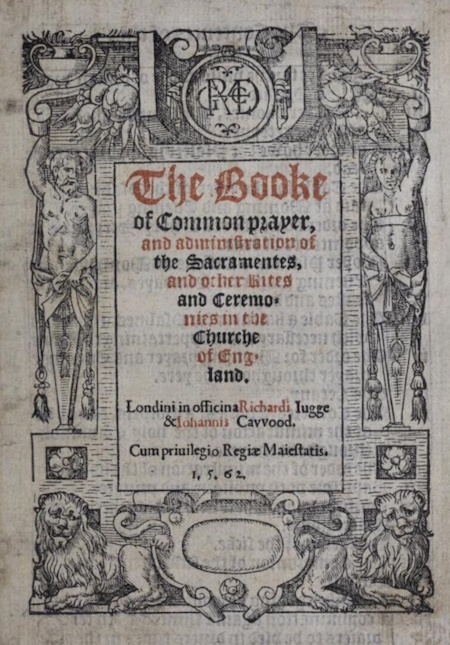
(ABOVE: The title page of a 1562 Richard Jugge and John Cawood printing of the 1559 Book of Common Prayer. This copy is currently Boston Public Library's Benton Collection of Editions of the Book of Common Prayer. Public domain, Wikimedia)
In his 1983 book The Anglican Spiritual Tradition, John R. H. Moorman, bishop of Ripon in the COE, helped readers see the Reformation’s tumult by imagining its effect on a fictional parish priest.
James Whyte . . . was born in the city of Colchester in 1499, in the reign of King Henry VII. . . . He was ordained priest in 1524 at the age of 25. . . . The first change which affected him was [in 1538] when he was told that he must get a copy of the whole Bible in English and set it up in his church where his people could come and read it. This surprised him a good deal, for he remembered well the days when to possess even a single sheet of an English Bible was forbidden. . . . Once, when he came into the church, he found William [the clerk] reading . . . and when he got to [Ephesians 4:11] he stopped and said: “You see, there’s nothing there about priests, is there?” James . . . told William pretty firmly that whereas he was entitled to read the Bible in public, he was not entitled to comment on it. . . .
HENRY VIII DIES, EDWARD VI FURTHERS REFORM
[In 1549] the form of worship. . . was swept away. The Latin Mass, which [James] had been saying daily for 22 years, was now made illegal.
As he read [the new Book of Common Prayer] through, however, he realized that things were not as bad as they might have been. The Mass was . . . in English; but the shape of the liturgy had been preserved and James was allowed to wear his customary vestments. He noticed also that there was now much more for the laity to do. . . . It was also more edifying, as a sermon had to be preached or a Homily read, at every Mass. So, on Whitsunday 1549, James Whyte led his people through the first celebration of the Mass in English. On the whole things went well, even at the administration of the Sacrament when, for the first time for 300 years or so, people were expected to drink from the chalice. . . .
In 1550 a great blow struck them . . . an act was passed which said, first of all, that all the books which had been used in the past . . . were to be completely destroyed . . . and, secondly, that all images or statues in the churches were to be defaced and destroyed. . . . James had to be away for some weeks during this summer but when he came back he was appalled at what he saw. The church he loved, with all its beauty and colour, was now bare and ugly. The walls, which had been covered with paintings were now white. . . . James was horrified for he had always believed that the church was designed to be a foretaste of heaven, with its richness and colour and with the reminder, in painting and in sculpture, of those who would be our fellow-citizens in the household of God. But all this had gone.
MARY RESTORES CATHOLIC WORSHIP (1553)
Most of James’s parishioners were quite happy to feel that there would be no more change and confusion. They had had to change their form of worship three times in five years, and surely that was enough. . . . Of course, the reformers had had some good ideas. He was quite happy saying all the church services in English and preaching to his people more than he had done in the past. And perhaps some of the little ceremonies were without much significance. But the desecration of the churches had troubled him, and he was bothered by new ideas about the priesthood and the Mass.
But now that things had returned to normal, James became saddened by the rigidity of the queen and her government, at the ruthlessness with which their opponents were silenced, and at the savage way in which a large number of misguided and more or less ignorant people were put to death. . . .
ELIZABETH RETURNS PROTESTANTISM (1559)
James, and all the other 9,000 clergy . . . had once more to change their way of life. Again the ornaments and furnishings, restored with so much difficulty five years ago, had to be removed from the churches. Again the missals and manuals had to be taken away and supplanted by an English Prayer Book not unlike that of 1552.
James was now 60 years old and had had enough … In spite of everything, he prayed that he would now be left in peace. After all, change had to come; and although much had been lost, there were things to be thankful for. One was the English Bible and the other was the Book of Common Prayer. With the help of these he could tell his parishioners the story of God’s work and of man’s redemption, and he could lead them in forms of worship which they could understand and in which they could take part.
By John R. H. Moorman
[Christian History originally published this article in Christian History Issue #160.0 in 2026]
John R. H. Moorman (Reprinted with permission from publishers Darton, Longman and Todd)Next articles


Making England good again
The Clapham Sect: Anglican activists of the late eighteenth and early nineteenth centuries
Karen Swallow Prior