“Further up and further in”


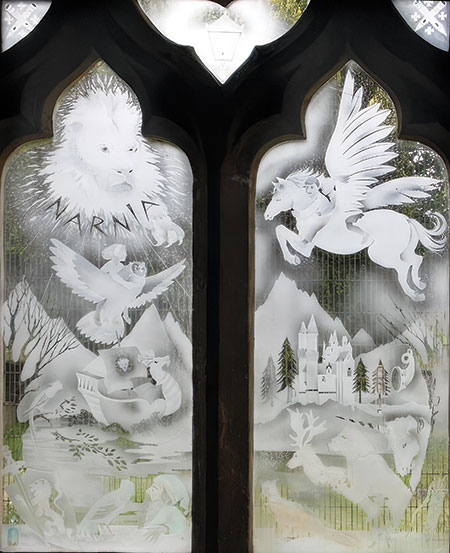
(ABOVE: Narnia window, Holy Trinity Church, Headington Quarry, Oxford—Image courtesy of Holy Trinity Church, Headington Quarry)
Clive Staples (C. S.) Lewis’s (1898–1963) rejection and eventual reconciliation with Christianity involved a labyrinth of complex experiences: his mother’s early death, an education that privileged rationality over faith, a world war that revealed devastation unparalleled in his lifetime. In his autobiography, Surprised by Joy (1955), Lewis writes that he was “the most dejected and reluctant convert in all England” when he finally admitted the existence of God.
In fact Lewis reveals that the whole experience felt as if he was a prodigal brought in “kicking, struggling, resentful, and darting his eyes in every direction for a chance to escape.” For him it was a bitter surrender at the conclusion of a long-fought intellectual battle. When Lewis finally returned as a travel-stained prodigal, he chose the faith of his boyhood: Anglicanism.
FROM DULL TO SPLENDID
Lewis grew up among strong Protestant traditions in Northern Ireland, which is part of the United Kingdom. His maternal grandfather, Rev. Thomas Hamilton (d. 1905), was an Anglican minister in the Church of Ireland, rector at St. Mark’s, Dundela, in Belfast. Hamilton trained at Trinity College, served as chaplain in the navy, and spent four years in Rome.
Reverend Hamilton openly expressed his disdain for Catholics (a view Lewis’s older brother, Warren, later condemned)—a political bias that left the youngest Lewis disgruntled with the church. Lewis’s parents emphasized the importance of Anglican faith, although they were not fanatical. He reveals in Surprised by Joy that his early life was not characterized by “a strict and vivid Puritanism.”
His perception shifted when churchgoing transformed from a “dull” obligation to the splendor of connection with a higher power. However, the journey was long and difficult. After his mother’s death, his old beliefs still nudged him. Young Lewis went to study with his father’s former schoolmaster, W. T. Kirkpatrick (1848–1921), whose emphasis on rationality helped Lewis lean firmly into atheism, but hope was not lost.
His first experience on his return to faith was reading George MacDonald’s (1824–1905) Phantastes as an adolescent, a reading colored by his continued fascination with myth. This fascination with “true myth” deepened when he befriended a circle of Christians in Oxford during his tenure as a don—a circle that included fantasy author J. R. R. Tolkien (1892–1973). All these experiences helped Lewis redefine his childhood faith as an adult. The fateful day when he rode in the sidecar of his brother’s motorcycle, an unwavering truth seemed to emerge from the dust clouds: Yes, Jesus is the Son of God.
A SENSIBLE FAITH
Anglicanism made sense to Lewis, so he resumed Anglican practices and beliefs, worshiping in the Church of England. Lewis’s biographer, George Sayer (1914–2005), wrote that Lewis regularly attended Holy Trinity Church not because he preferred it but because it was the closest parish to his home at The Kilns. His new approach to faith valued love and tolerance. Collective conformity was not paramount; community was. This attitude certainly inspired what would become one of Lewis’s most famous works: Mere Christianity.
Joy Davidman Lewis (1915–1960) said of her husband that he wasn’t high church but a “tough Ulsterman” (from Ulster, Ireland) with the views of an “Orangeman” (strong Protestant), although he approached life with “half [humour].” Lewis’s mature faith allowed him to navigate the complexities of theology, to appreciate a diversity of beliefs, and to love his neighbor without the political burdens of his past.
By Crystal Hurd
[Christian History originally published this article in Christian History Issue #160.0 in 2026]
Crystal Hurd, educator, researcher, poet, and recipient of the 2025 Paul F. Ford Award for Excellence in Lewis Scholarship in Teaching and WritingNext articles
Preaching, writing, caring, transforming
Faces of Anglicanism in the twenty-first century
Jennifer A. Boardman
The road from Canterbury
an Anglican roundtable discussion
Michael Matlock, Elise Johnstone, Matthew Barrett, Bruce Cory