The raw materials of Anglicanism


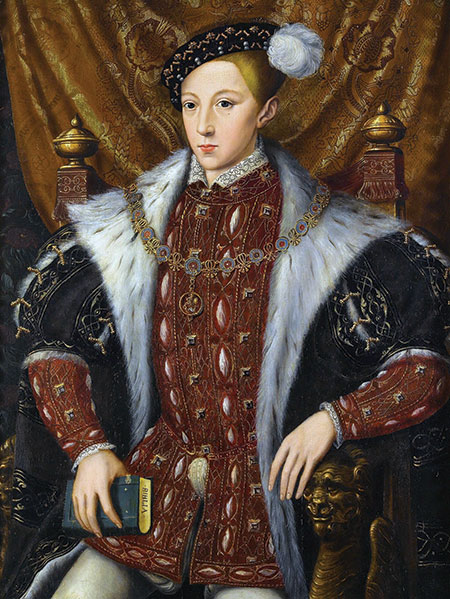
(ABOVE: Circle of William Scrots, Portrait of Edward VI of England, 16th cent. (oil on panel)—Sotheby’s / Public domain, Wikimedia Commons)
The word “Anglican” has a curious history. Although it appears at various moments in medieval and early modern sources, it is only long after the sixteenth century that some Christians understood themselves to be part of a distinct religious tradition called “Anglicanism.” But to arrive at that place, to find a tradition with an emerging global presence distinct from merely the English state church, a unique spirituality and liturgical inheritance, and an identifiable body of theological reflection, one must grapple with the various movements for reform in the sixteenth century. These were the raw materials for what would become Anglicanism.
THE KING’S “GREAT MATTER”
Henry VIII (1491–1547, r. 1509–1547) was a devoutly conservative Catholic in the 1520s. But by the close of that decade, the king wrestled with the question of his succession. He had only one legitimate child, his daughter Mary, and he wondered whether his lack of heirs was due to sin—perhaps his marriage to his late brother’s wife, the Spanish princess Katherine of Aragon (1485–1536), was incestuous. Only a generation earlier, England had lived through a dynastic civil war, and questions of his own dynasty’s legitimacy lingered. The succession anxieties were compounded by Henry’s roving eye, which had become fixed on Anne Boleyn (d. 1536). By the start of the 1530s, Henry wanted to end his marriage to Katherine. But how, since divorce was illegal? This project became known as the “King’s Great Matter.”
Henry’s advisors took a variety of approaches including hosting a papal legate (personal representative of the pope) in England. Then in 1532 a middle-aged don from Cambridge suggested that the theological faculties of European universities ought to be canvassed for their opinion. That don was Thomas Cranmer (1489–1556; see p. 14 and CH #48). Although his strategy proved unfruitful, Cranmer had another option. He scoured history to identify moments in which the king was supreme in his lands, not only in matters civil but also spiritual.
For his efforts Cranmer was consecrated archbishop of Canterbury in March 1533 and two months later declared Henry’s marriage to Katherine invalid. By the next year, Parliament had passed the Act of Supremacy declaring that Henry had always been the supreme head of the English church and that the pope had no authority in England. Pope Clement VII (r. 1523–1534) excommunicated Henry and all his advisors.
But what actually changed for the English people? Although the Latin Mass continued, some could not accept a rupture with Rome. Those who refused to recognize Henry’s supremacy faced execution. Prominent examples were Henry’s former chancellor Thomas More (1478–1535) and Bishop John Fisher (1469–1535). Arguably the most important development in Henry’s reformation was the dissolution of the monasteries: the closure of centuries-old abbeys and the confiscation of their buildings.
What, though, of “Protestantism”? Luther’s Ninety-Five Theses (1517) and his excommunication (1521) were old news by then. The Lutheran princes of Germany had already won something of a grudging recognition from the emperor in their Augsburg Confession. Likewise the Reformed tradition, one distinct from the Lutherans, was emerging in the urban communities of southern Germany and Switzerland. For the rest of Henry’s reign, his advisors seesawed back and forth between potential reform efforts, debating, for example, the place of private confession, prayers for the dead, and the possibility of clerical marriage. Cranmer, unlike others, navigated the challenges of Henry’s court, and in the reign of his son, Edward VI (1537–1553), orchestrated a reformation project more consonant with the Reformed tradition of Switzerland.
REIGNS AND REFORMS
Following the end of his marriage with Katherine of Aragon, Henry VIII went through a series of wives, making the story of his reign something of a soap opera. The sum of all his marriages, however, was that at Henry’s death in 1547, his son by his third wife (Jane Seymour)—Edward— succeeded him: a nine-year-old boy. Henry also had Mary by wife #1, Katherine of Aragon; and another daughter, Elizabeth, by wife #2, Anne Boleyn. On his accession in 1547, the boy-king Edward was surrounded by a group of counselors led by Cranmer. They moved the Church of England toward worship in English instead of Latin, eliminated medieval Catholic devotional mainstays like shrines and images, increased preaching, and wrote a formal collection of 42 doctrinal articles that, while cautious, aligned with the Reformed more than with the Lutherans. Cranmer also set to work inviting celebrity Reformed theologians to teaching positions at Oxford and Cambridge.
The most obvious aspect of Edward’s reformation agenda was the Book of Common Prayer (BCP), which first appeared in 1549. This fairly restrained first liturgical outing was replaced in 1552 with a more thorough version. The BCP was both conservative and revolutionary. It continued a trend in medieval worship: the steady effort to make liturgy uniform across a kingdom. The Roman Catholic Council of Trent did the same thing, creating a “common” Tridentine Mass in 1570. But the BCP also swept away local patterns and had England praying in unison.
Although reforms meant images were removed and stone altars torn down, the prayer book required a material context and a conservative approach to feasts and seasons that effectively set the Church of England apart from other Reformed churches. Many medieval vestments were banned, but clergy were still ordered to wear the surplice (the white gown). The Church of England retained the threefold order of ministry (deacons, priests, and bishops), as well as the unique role of the cathedrals, often with elaborate repertoires of liturgical music. Edward’s regime also produced a handy collection of sermons for clergy, the Book of Homilies. Cranmer prepared a Reformed canon law but could not get it through Parliament before Edward VI’s untimely death at 16 in 1553.
Despite a failed attempt to prop up a Protestant successor through Edward’s cousin, Lady Jane Grey (1537–1554), the English crown went next to Mary (1516–1558). The new queen, a staunch Catholic, attempted a wholesale reversal of both Edward’s and Henry’s reformation projects. After arresting many bishops, including the aged Cranmer, Mary reintroduced the Latin Mass and rebuilt shrines. In November 1554 Mary’s cousin, Cardinal Reginald Pole, held a grand reconciliation ceremony at Westminster absolving the kingdom of heresy. Mary is best known for burning Protestants as heretics, including Cranmer in 1556.
ELIZABETH’S ENGLAND
English Christians had faced a dizzying series of religious changes in the space of a generation (see p. 10). Some spoke up and faced serious consequences, even execution. Catholics suffered under Edward. Protestants suffered under Mary. Edward and Mary would, however, come to have something in common: a short reign marked by an unexpected death. When Mary died in 1558, having reigned for only five years, England had already lived through a convulsed age. Henry, Edward, and Mary had each endeavored to reshape the religious life of the kingdom. This was the landscape inherited by the last of Henry VIII’s heirs, his middle child, Elizabeth (1533–1603).
“This is the Lord’s doing,” Elizabeth recited from the Psalms on news of her accession, “and it is marvelous in our eyes.” Elizabeth Tudor was educated by Reformed chaplains and was unequivocally a Protestant. Dismissing the monks of Westminster who greeted her at her coronation, the new queen reasserted the Book of Common Prayer and named reliably Reformed men as bishops. But those Reformed men joined her in freezing the Church of England in place. Cranmer’s project, clipped by Edward VI’s death back in 1553, was an agenda in steady motion toward conformity with the churches of Switzerland. Elizabeth, though Protestant, desired no further “progress.” The people of England, whether Catholics distressed by the abolition of the Mass or Protestants distressed that England had not been reformed enough, had to present themselves for prayer-book worship. Elizabeth took as her motto, semper eadem, “always the same.” Through the rest of her long, steady reign, she faced challenges. From Catholics she faced conspiracies, assassination attempts, and even an attempted invasion in 1588 by Catholic Spain (see painting above). On the other hand, she perceived Puritans, those who called for the abolition of bishops and the prayer book, as insolent and undermining (see p. 28).
By the close of Elizabeth’s reign in 1603, the Church of England was still part of an international family of Reformed churches. Representatives from the Church of England even showed up at the Calvinist Synod of Dort (1618–1619). But the Church of England remained the outlier. England’s Articles of Religion, reduced from 42 to 39, were clearly Protestant, but their language about justification by grace was not as explicit about “double predestination,” the notion that God not only decrees some for eternal life but actively decrees some for damnation.
Likewise the clergy wore surplices and the church observed feast days and celebrated Holy Communion roughly four to six times a year (more frequently in the cathedrals). The church’s star theologian in the 1590s, Richard Hooker, argued that the church’s mission rested on God’s good order and that the queen was entrusted with seeing it through. Although the Church of England at the close of Elizabeth’s reign was a Reformed church, its peculiarities left open a door in the seventeenth century to its becoming a distinctly unique tradition (see pp. 15–17). Consequently, from the raw materials of this reformation, would later come something called “Anglicanism.” CH
By Calvin Lane
[Christian History originally published this article in Christian History Issue #160.0 in 2026]
Calvin Lane is affiliate professor at Nashotah House, author of two books on the Reformation, and editor of Covenant: The Online Journal of the Living Church.Next articles


Making England good again
The Clapham Sect: Anglican activists of the late eighteenth and early nineteenth centuries
Karen Swallow Prior