United in protest


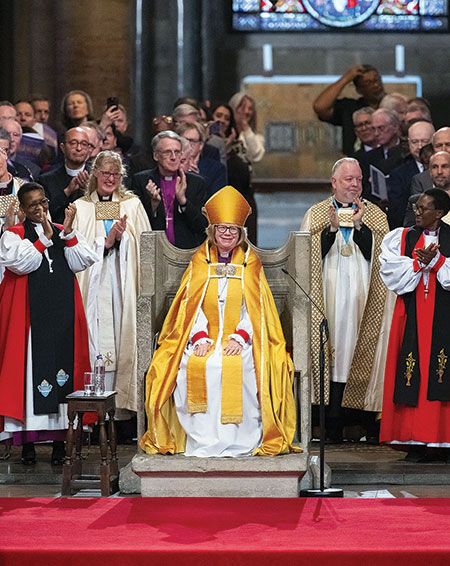
(ABOVE: Newly consecrated Archbishop of Canterbury Sarah Mullally flanked by female bishops from Africa, Canterbury Cathedral, 25 March 2026—Photograph courtesy of the Lambeth Palace Press Office)
The Anglican Church of North America (ACNA) came into being in 2009 as a protest against the erosion of traditional Anglican values within the Episcopal Church of the USA (TEC) and the Anglican Church of Canada. One trigger to leave TEC had been the election of Gene Robinson, a gay man in a same-sex partnership, to the episcopacy in 2003. But tensions had been brewing for decades over what conservative Episcopalians considered to be an overemphasis on secular human-rights issues at the expense of core Christian doctrines and ethical concerns. Women’s ordination was a sensitive issue, particularly for those from an Anglo-Catholic tradition; also the promotion of LGBTQA+ rights was seen as contrary to biblical values and Christian sexual morality.
APPEAL TO AFRICA
As a minority within TEC, conservatives looked to the worldwide Anglican Communion, particularly to churches in Africa, for support. Some feared that the 1998 Lambeth Conference (see p. 1) would make moves to support gay relationships. Conservative American Episcopalians urgently alerted African and Asian bishops to this danger. They successfully created a robust body of bishops at Lambeth who opposed such a move, producing a strong statement that homosexual relations are unbiblical. This was called the Lambeth 1:10 Resolution, and it read in part that the conference “upholds faithfulness in marriage between a man and a woman in lifelong union, and believes that abstinence is right for those who are not called to marriage.”
American conservatives might naturally have felt more kinship with the church in South Africa, but the immensely influential Archbishop Desmond Tutu of the South African church was clear that a church that had strenuously opposed apartheid on the grounds of race could not now discriminate against people on the grounds of sexuality. The large, dynamic evangelical and biblically orthodox churches of Nigeria and Uganda proved more sympathetic. In 2006 Archbishops Peter Akinola (b. 1944) of Nigeria and Henry Orombi of Uganda (b. 1949) became instrumental in the creation of the Global Anglican Futures Conference (GAFCON) and its Jerusalem Declaration reaffirming opposition to gay inclusion.
On its formation the ACNA was welcomed as a full member of GAFCON, even though the ACNA was not part of the Anglican Communion. The churches in both Nigeria and Uganda made the decision to refuse any financial help from TEC. The small Anglican Church in Rwanda, recovering from the devastating genocide of 1994, soon became a focus for ACNA support.
In both Nigeria and Uganda, the controversy has had a wider effect on society, creating concerns about a “gay agenda” aimed at subverting traditional African values, resulting in legislation to ban homosexual practice and same-sex marriage. The conflict has also raised the question of how to escape the colonial heritage of a Western-dominated Anglicanism.
The relationship between the ACNA and African Anglicans has, however, not been without its problems. Many African Anglicans ordain women to the priesthood and some to the episcopate (currently only men can be ordained to the episcopate in the ACNA). Six African female bishops attended the installation of Sarah Mullally as archbishop of Canterbury in 2026 (see p. 44).
Regardless the ACNA sought to create an alternate to Canterbury in the worldwide Anglican Communion. In 2026 in Abuja, the capital of Nigeria, they met to begin this process, stating, “Reordering the Anglican Communion is now necessary,” but held back from appointing a single alternative archbishop.
By Kevin Ward
[Christian History originally published this article in Christian History Issue #160.0 in 2026]
Kevin Ward, retired associate professor at the University of LeedsNext articles

Recommended resources: Anglicans
Discover the history of the Anglicans—in England, the United States, and worldwide—with these resources recommended by our editors and authors.
the editoris
Questions for reflection: Anglicans
Use these questions to help guide your understanding of the Anglican story.
the editors