Divided kingdom


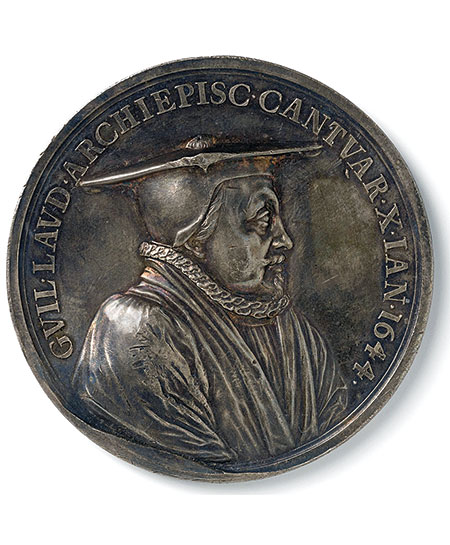
(Jean Roëttiers (artist), Silver medal in honor of William Laud, Archbishop of Canterbury, 1644—[Public Domain Mark 1.0 Universal] RijksMuseum NG-VG-1-749 / Wikimedia Commons)
Devils in Samuel’s Likeness have dangerously deceived us; the Spirits of Lies have [laid] in wait to wrest unstable Souls & have drawn thousands from the truth, the vessels of wrath have poured themselves forth upon our earth and have filled it with a deluge of devastations; the Revengers of wickedness have plagued both persons and places for their Long settled but not sorrowed for wantonness . . . .
—From the Notebook of Archibald Sparke, a priest in Wales, c. 1650–1667 (modernized)
England’s slow spiral into civil war both surprised and deeply wounded those who experienced it. All parties, such as Welsh priest Archibald Sparke, portrayed the fracturing of church and state as God’s punishment upon a sinful nation. People often attributed that sinfulness to their religious and political opponents. The full story, of course, is more complicated than that.
CONFORMITY AND DISCONTENT
When James VI (of Scotland; 1566–1625) ascended to the throne of England and Ireland in 1603 as James I, he inherited a Church of England that served as a stabilizing and unifying force in England and Wales. Despite coming from Calvinist Scotland, James was disinclined to disturb the established church or to institute further religious reform, even with early and sustained pressure from a vocal minority of largely Calvinist Puritan MPs (members of Parliament) and clergy. The Millenary Petition of 1603 purported to be signed by a thousand clergy who described themselves as “groaning as under a common burden of human rites and ceremonies.” They called for an end to confirmation services, the use of the cross in baptism, and absentee clergy; they also demanded freedom to preach without fear of sanction.
Furthermore, Puritan MPs called for reform to the Book of Common Prayer (BCP) and to church discipline, but to no avail. James admired the English episcopal system precisely because it subordinated the church to the monarch—the very arrangement Puritans sought to dismantle. Following a conference of the church at Hampton Court, James proclaimed in 1604 that “no well-grounded matter appeared to us . . . why the state of the Church should in any material point be altered.” Instead he enforced conformity, resulting in the ejection of roughly 90 Puritan clergy.
Toward the end of his reign, James promoted anti-Calvinist churchmen, for example William Laud (1573–1645), who become bishop of St. Davids (Wales). Yet it was James’s son Charles I (1600–1649) to whom anti-Calvinism, discipline, and order in the church appealed most. Laud became archbishop of Canterbury in 1633 and, with Charles, initiated reforms that prioritized the “beauty of holiness” in worship. Those who resisted faced punishment in courts, such as the Court of Star Chamber, which were directly under the Crown’s control.
As part of his effort for religious unity across his kingdoms, Charles tried to introduce the English prayer book into Scotland. The attempt was disastrous. The resentful Scottish church (the Kirk) and the Scottish Parliament, whom Charles never consulted, saw the new prayer book as both an unwelcome religious change and an English imposition. Resistance to this overstep, in the form of the Covenanter movement, ultimately resulted in war. The Scottish Covenanters defeated Charles in the Bishops’ Wars, serving as one key factor leading to civil war in 1642.
When the Long Parliament met on November 3, 1640, prominent opponents of King Charles I (such as MP and future lord protector, Oliver Cromwell; 1599–1658) sought redress for long-held grievances, not least the policies of Archbishop Laud. (Laud himself was arrested, imprisoned and, after four years and a failed trial, executed in 1645.) In the early months, MPs were unified, but this soon ended. Once a powerful Puritan party, led by John Pym (1584–1643), took control, more moderate voices—which included defenders of the Church of England—lost influence. (Many Puritans were parliamentarians—those who sought to limit the monarchy’s power and give parliament more authority instead.)
Moderates mustered signatures on pro-church and pro-king petitions to rival those of the Puritan party, to oppose iconoclasm, and to protect traditional church practices. Consequently moderates often found themselves in the royalist camp—those who supported the Crown.
Civil war broke out in August 1642, devastating all the British kingdoms. One historian has estimated that over 25 percent of English buildings were destroyed, and the death toll was, in proportion to the population, greater than Britain’s in World War I. In many areas continued adherence to the Church of England became a marker of loyalty to the king and the royalist cause. In parliamentarian areas after 1642, clergy who supported the king or who decried Parliament were ejected from their livings. Statues, rood screens, stained glass, and fonts were destroyed or removed as remnants of “popery.” When parliamentarian armies occupied royalist areas, their inhabitants lamented the destruction of church furniture, organs, and on one occasion in Wales, Bibles bound with the BCP.
The 1646 parliamentarian victory led to continued civil war and an outright ban on the Church of England, its bishops, and its traditional liturgies. Waves of ejections took place across England and Wales, particularly in former royalist territories. Clergy were fined and removed from their livings. In 1653 Cromwell became lord protector.
CHURCH UNDER FIRE
Although persecution was uneven from 1646 to 1660, many still experienced it. Laity faced prosecution for being married in church by clergy, having baptisms with godparents, and attending traditional services on Sundays. That said, services continued in varying degrees of secrecy. In many rural areas, attending an episcopal service appears to have been relatively easy. Such practices sometimes became part of a popular cause; the Rump Parliament, active after the civil wars ended, banned Christmas services and festivities, resulting in the pro-Christmas riots of 1652.
Episcopal activists supported ejected clergy, providing them space in gentry houses to continue traditional services. This network maintained the Church of England, aided by a general fondness for traditions such as “greening the church.” That the church survived nearly 20 years of such mistreatment is a testament both to that support network and to the deep-seated religious traditions of England and Wales—the roots of which, in some cases, stretched back before the Reformation itself (see pp. 6–9).
After Cromwell’s death in 1658 and the return of the Long Parliament, Charles II (exiled son of Charles I) was invited back to England to restore the monarchy. In the Declaration of Breda (April 1660) Charles declared that he would respect religious toleration insofar as it did not threaten the peace of the kingdom. He tended toward toleration of Presbyterians and less radical Puritan groups, which greatly encouraged some to support his Restoration. Such hopes, however, would prove short-lived. After the election of the Cavalier Parliament (1661–1679), composed largely of royalist campaigners and strong supporters of the Church of England, Charles interpreted nonconformists as threats to the peace and banned them from holding public office or religious services (see p. 28).
Indeed, for MPs elected in 1661, nonconformity posed an existential threat. Many had personally experienced land seizure, exile, or prosecution during the regime interim, or knew those who had. They feared that 1641 would “come again,” toppling the kingdom into civil war. As a result radicals who had governed, raised taxes, or worked for parliamentarian governments were harassed, closely monitored, and in some cases arrested or physically attacked.
More positively, traditional church liturgy and customs returned to general approval. New “traditions” commemorated the monarchy’s return, including the celebration of the Feast of St. Charles, King and Martyr. The BCP lectionary places this feast day annually on January 30.
According to historians such as Kenneth Fincham and Stephen Taylor, Anglicanism as it was until the twentieth century was born at the Restoration. This does not mean that it was monolithic and undivided. Its members—including theologians, bishops, and chaplains of nobles—still debated multiple issues. Although Charles II and his government weathered these storms, and his brother James II (1633–1701) inherited the throne smoothly on Charles’s death in 1685, the Church of England was headed for further dispute and controversy in the years to come.
POPERY AND TYRANNY?
Despite a promising start, James II was a difficult monarch for Anglicans to support loyally. James promoted Catholics and dissenters to key positions in national and local governments and rewrote town charters to gain a stronger hold on power. Loyalist Anglicans deeply resented this interference. They saw James’s attempts to grant toleration for Catholics as tyranny, gaining him the reputation as an agent of the pope. This anti-Catholic sentiment increased with the birth of James’s son and heir.
The prospect of a Catholic dynasty united churchmen and politicians, ultimately resulting in an invitation for William of Orange (1650–1702; the king’s nephew and son-in-law, married to his daughter Mary) to invade. William arrived in England in November 1688. The invasion and deposition of James II were portrayed as a noble Protestant cause, aimed at saving the nation from tyranny and popery, and safeguarding the English church. Though lauded as saviors, ultimately William and Mary did little to heal the divisions within the church or the kingdom. CH
By Sarah Ward Clavier
[Christian History originally published this article in Christian History Issue #160.0 in 2026]
Sarah Ward Clavier is associate professor of early modern history at the University of the West of England and author of Royalism, Religion, and Revolution: Wales, 1640–1688.Next articles
Making England good again
The Clapham Sect: Anglican activists of the late eighteenth and early nineteenth centuries
Karen Swallow Prior


“The sacred gift has been handed down”
Tracts for the Times was a series of 90 essays published between 1833 and 1841 by members of the Oxford Movement in the Church of England. Below are some excerpts that show their desire to move Anglican doctrine and practice closer to a Catholic model.
tractarians