Generations upon generations


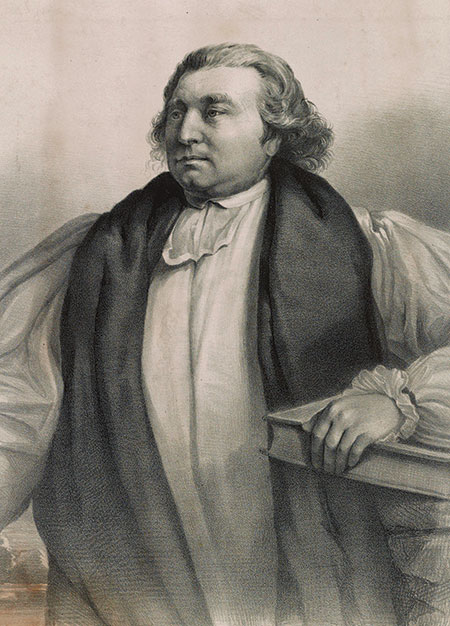
(ABOVE: Rt. Rev. Samuel Seabury, D.D., first bishop of Connecticut (print)—Public domain, Library of Congress)
Anglicanism came to North America with the English—and it came first. Thirteen years before the dissenting Pilgrims (see p. 28) landed, settlers established the first permanent English-speaking colony in 1607 after several other failed attempts. Supposedly their chaplain, Robert Hunt (c. 1568–1608), prayed that day,
We do hereby dedicate this Land, and ourselves, to reach the People within these shores with the Gospel of Jesus Christ, and to raise up Godly generations after us, and with these generations take the Kingdom of God to all the earth. . . . From these very shores the gospel shall go forth, not only to this new world, but the entire world.
The Virginia Company, an English trading company (the name honored the late Elizabeth I), held a charter from King James I to colonize a portion of the coast. They named it Virginia and their new settlement after the king: Jamestown. From here Anglican influence spread outward. By 1609 the Church of England was the established church in colonial Virginia; eventually the Virginia model would be mirrored in Maryland, South Carolina, North Carolina, and Georgia in the eighteenth century. However, Anglicans were soon numerically surpassed first by Congregationalists, on and off by Presbyterians, and eventually (by the early nineteenth century) by Methodists.
AMERICANIZING ANGLICANISM
Anglican colonists still worshiped according to the Book of Common Prayer; they had priests and deacons (not as many of them as in England), but no bishops. The entire colonial system was under the authority of the bishop of London, and commissaries represented him in the colonies. A parish system similar to the English one also existed, and “glebes” (land for the support of the church) were established. During the English Civil War (1642–1651), Oliver Cromwell sent ships to Virginia to ask settlers to acknowledge his leadership and cease prayer-book worship, but the request made little difference to colonial practices.
Right away the harsher environment and great distance from the English church meant changes, beginning with vestry governance. Vestries (see inside front cover) had been part of the English church for 300 years, but gained more power in colonial America, including the power to select clergy for their parish. This would later become the practice of the entire American church.
Missionary societies helped spread Anglicanism. Thomas Bray (1656–1730), the Maryland commissary, founded the Society for Promoting Christian Knowledge in 1698 with a major focus being catechesis of British colonists and the building up of colonial Anglican libraries. After traveling to Maryland in 1700 and being unable to obtain a stipend from the colonial government, he went home to England and founded an organization to support colonial clergy and missionaries, the Society for the Propagation of the Gospel, in 1701. Finally in 1724 Bray founded a third organization, Dr. Bray’s Associates, which supported ministry to Black Americans.
The church was small but thriving. In 1724, 161 parishes existed throughout the American colonies, all the way from Massachusetts to South Carolina (up from 85 in the late seventeenth century). In the words of historian Robert Prichard, “Clergy reported full churches in times of fair weather, ministry to African Americans, and a rate of receiving holy communion greater than that in England.” Many of the clergy and people reflected a rational, intellectual, and moderately high church theological orientation.
Soon, however, the religious mood shifted—and it would be an Anglican, George Whitefield (1714–1770), who would shift it. Whitefield first arrived in the colonies in 1738 to take up work begun by John and Charles Wesley in Savannah, Georgia. When Whitefield returned in 1740, his preaching tour over the next year electrified colonial America. He established relationships with revival-minded clergy of every denomination (while also becoming a close confidant of deist Benajmin Franklin, 1706–1790) and preached to thousands—maybe as many as 15,000 people at once. In the end he made seven trips to the colonies and died there on his last one.
While Whitefield never left the Church of England, he soon ran afoul of Anglican leaders for his dramatic and emotional preaching, willingness to engage in extemporaneous prayer, and rejection of the need for episcopal ordination. Those opposed to Whitfield’s emotional methods used higher education to combat revivalism and also organized conventions to discuss the issues and petition the English church, once again, for colonial bishops.
By the 1760s younger clergy proved willing to adapt a more revivalistic approach—modern hymns, lively preaching, prayer groups—while keeping within the bounds of prayer-book worship and episcopal governance. In addition Methodist societies were growing separately—and Methodism, while clearly an evangelical revival movement, was also a Church of England renewal organization. This tension between high and evangelical Anglicans would remain a prominent feature of American Anglicanism.
REVOLUTIONIZED IDENTITY
And then came the Revolution. Although in practice many Anglicans supported the colonial cause, the Revolution cut them off from the king to whom their priests had pledged loyalty and for whom they prayed every Sunday—and the taxes that supported their churches. How could they constitute themselves as the Church of England in what was no longer a colony of England?
There were talks with the Methodists, who ultimately organized in 1784 as a separate denomination, and there were efforts in both Philadelphia (led by William White, 1748–1836) and Connecticut (led by Samuel Seabury, 1729–1796) to propose organizational plans for a new church. The Connecticut group sent Seabury to England to seek consecration as a bishop; while the English Parliament was figuring out how to consecrate someone who could not swear loyalty to the king, he went to Scotland, where three bishops of the Scottish Episcopal Church consecrated him in 1784. He began ordaining clergy in America in 1785.
Finally, in 1785, the organizing groups held the first General Convention of what they named the Protestant Episcopal Church in the United States of America. They proposed a new form of the Book of Common Prayer (without prayers for the king), which was ratified in 1789, and arranged for governance by a bicameral General Convention. Seabury, along with White and Samuel Provoost (1742–1815), both consecrated in England in 1787, became the first bishops; White became the first presiding bishop. In 1789 the General Convention formally declared the Episcopal Church’s separation from the Church of England. On paper they had a church.
On the ground the situation looked a little rockier. Only about 10,000 Episcopalians occupied the new United States. It took North Carolina until 1817 and Georgia (which only had one functioning church) until 1823 to send any delegates to the General Convention. Provoost disliked being bishop so much that he retired in 1801 and became an amateur botanist. But slowly a new generation began to expand, evangelize, debate, and reorganize.
By 1830 the church had multiplied threefold with around 30,000 members. By the time of the Civil War, it would have over 150,000. New leadership arose as well, including Bishop John Henry Hobart of New York (1775–1830), consecrated in 1811. He founded the church’s first seminary in 1817—the high church General Theological Seminary in New York—and worked energetically to spread the faith.
The also thriving but much more evangelical Anglicanism of Virginia counteracted Hobart, where the Protestant Episcopal Seminary of Virginia (today Virginia Theological Seminary) was founded in 1823. Episcopalians also moved west, with dioceses formed in Ohio (1819) and Kentucky (1832). The church formally reorganized its missionary efforts in 1835 and appointed missionary bishop Jackson Kemper (1789–1870) to oversee the work. It also sent missionaries abroad—initially to Greece, China, and Liberia.
Like every other American denomination, Episcopalians had to wrestle with the issue of Black enslavement. There had been Black Episcopalians since the 1790s, when Absalom Jones (1746–1818), one of a group of Black Christians who had left Methodism over racist treatment, founded St. Thomas Church in Philadelphia, Pennsylvania. (One of Jones’s original compatriots, Richard Allen, 1760–1831, would become the founding bishop of the African Methodist Episcopal Church.) Jones was ordained a deacon in 1795 and the first Black Episcopal priest in 1802, but his followers remained second-class citizens in the local Episcopal church. While individual Episcopalians supported abolitionism, mostly the church did not speak out against enslavement, especially since many high church Episcopalians frowned on political participation. (Hobart, for example, refused to vote.) During the Civil War, the church briefly met in two different General Conventions, North and South, but reunited in 1865.
SHIFTS AND DIVISIONS
The high-church-versus-evangelical debate changed shape as influences from the Oxford Movement (see pp. 22–24) began to cross the Atlantic. In its English contex, the Oxford Movement had begun as a political and philosophical debate, but its leaders had come to appreciate early and medieval liturgical practices. The liturgical aspect proved most influential in America.
In 1845 William Augustus Muhlenberg (1796–1877) presided over the very first establishment of a Protestant religious order for women to minister to the poor and sick; by 1880, 13 orders of Episcopal nuns existed. By the 1860s American Anglo-Catholic Episcopalians were buying vestments for their clergy, chanting parts of the liturgy, using candles and incense, and building Gothic churches. Conflicts over liturgical practices, differing opinions on other Protestants preaching and presiding in Episcopal churches, and debate over baptismal regeneration versus a revivalistic personal conversion reached a tipping point. The Reformed Episcopal Church (REC) formed in 1873 as a result.
With the departure of many (although not all) evangelicals to the REC and the Episcopal Church’s post-1867 participation in a once-a-decade gathering of worldwide Anglican bishops at Lambeth Palace, many American Anglicans began to define themselves—and Anglicanism as a whole—as a separate religious tradition, not merely a branch of Reformed Christianity or even, for some, of Protestantism itself. It was in this era that the terms “Anglican” and “Anglican Communion” first came to be widely used for worldwide churches that trace their heritage back to the Church of England.
NO SUCH THING AS A HERETIC?
In the twentieth century, the church also began to define itself as something else: broad (see p. 33). For years the greatest tensions in the Episcopal Church had been between the high and low branches; now tension arose between these branches and those who favored a more expansive interpretation of Scripture and the Book of Common Prayer. The church generally took an expansive approach, although one bishop, William Montgomery Brown (1855–1937), did get defrocked for heresy. A 1924 Time article about the case titled “Bad Bishop” noted, “If there can be such a thing as a heretic (i.e., one who disbelieves what a church believes), Bishop Brown was a heretic. Bishop Brown, however, contended there is no such thing as a heretic.”
The church’s identity as a mainline denomination—in the center of American Protestant religious life and connected to other organized, educated, powerful Protestant denominations such as Presbyterian, Congregationalist, and Methodist—became important to it. The denomination had seminaries, colleges, missions, good ecumenical relationships, a bureaucracy, a full-time presiding bishop, clergy, and a popular prayer book (updated in 1928). Membership peaked at 3.6 million in 1966.
But long-standing tensions among high, low, and broad resurfaced. Conservative resistance in the 1970s focused on the ordination of women, regularized at the 1976 General Convention (some women had been irregularly ordained prior to this), and on the development of a 1979 Book of Common Prayer revision. The new book incorporated insights from Vatican II and the resulting liturgical movement (see CH #157) and overhauled the 1928 version. Those who rejected these developments as well as general theological liberalism and broadening attitudes toward human sexuality in the church, became known as “continuing” Anglicans (see p. 1). Ultimately many would become part of the Anglican Church of North America (see pp. 48–49).
Today it is hard to find someone, inside of it or outside, who remains neutral about the Episcopal Church. Nevertheless it continues as one of the most influential expressions of Anglican Christianity worldwide. Robert Hunt could not have predicted the generations that would come after him, nor the way the continent would be transformed. CH
By Jennifer Woodruff Tait
[Christian History originally published this article in Christian History Issue #160.0 in 2026]
Jennifer Woodruff Tait is senior editor of CH.Next articles

To the ends of the earth and back again
How Anglican missionaries spread the Gospel both near and far
Jonathan S. Riches
No poet is an island
Some writers whose Anglican faith was central to their work
Karen Swallow Prior