Saving Anglicanism?


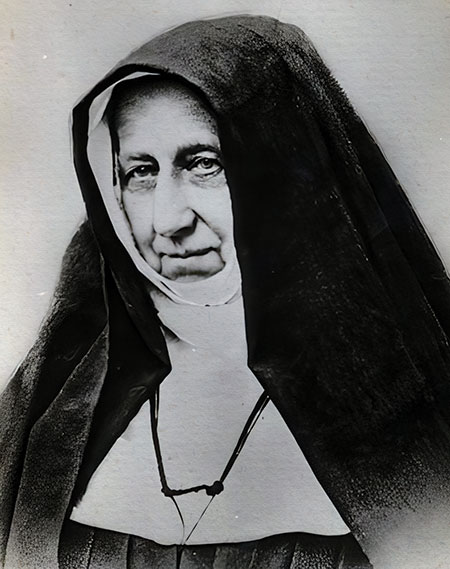
(ABOVE: Sister Marian Rebecca Hughes—OxfordHistory.org / Public domain, Wikimedia Commons)
By the mid-nineteenth century, Anglican priest and writer John Henry Newman (1801–1890) identified a growing problem in the Church of England. Modernist tendencies, including ideas of revolution and rationalism, were creeping into the ideology of the church. As democratic impulses swept through the country, members of Parliament became increasingly less Anglican—dissenters filled government seats, eroding the power and practice of Anglicanism and dissolving the state’s centuries-long commitment to the Church of England.
Newman was also vociferously against what he called “liberalism,” free thought opposed to hierarchical power and authority. Free-thinkers, he believed, opposed the principle of the apostolic succession, the God-given power and authority of priests and bishops. This ancient idea, which went back to the first disciples of Christ, would be the means, Newman believed, to save Anglicanism from the widespread forces of change occurring during his lifetime.
Modernity, at the same time, was slowly moving people away from faith and belief in the supernatural to skepticism, doubt, and rationality. It also was leading to teachings he abhorred as heretical, such as Unitarianism and Universalism.
A SECOND REFORMATION?
Newman was not the only one. Other Oxford divines—theologians and clergymen educated at Oxford University and other bastions of conservatism—joined Newman in the protest against a liberalized church, forming the Oxford Movement.
The leaders of the movement included John Keble (1792–1866), professor, minister, and poet; Edward Pusey (1800–1882), professor and theologian; Richard Hurrell Froude (1803–1836), Oxford tutor and priest, author of the posthumously published Remains; and William G. Ward (1812–1882), theologian, publisher, and writer. Newman remained the movement’s most prominent figure (though he would eventually convert to the Roman Catholic Church).
In 1833 Newman initiated the Tracts for Our Times, a series of 90 tracts published until 1841. Though Newman himself was the chief contributor, he credited the movement’s actual beginnings to John Keble’s sermon on the “National Apostasy,” which outlined how the state was distancing itself from the established church.
Newman, his friends, and colleagues followed up this first public statement with a series of short essays, the Tracts, published in London. The Tracts argued for what Newman called a “Second Reformation” to counter what he and others thought was backsliding by the Church of England. (Because of the Tracts, the reformers were often called Tractarians.)
Oxford Movement writers argued against the modern church, accusing it of ignoring important early church practices, adopting a less rigorous stance in liturgy and rituals, and giving into forces then sweeping throughout England, Europe, and the world. The Tracts themselves gave voice to Anglo-Catholic strains within Anglicanism—that is, an approach to liturgy and ritual that is more Catholic in practice. In the “Advertisement for the Tracts,” Newman wrote that people left the Church of England because they no longer cared for the sacraments; they instead wanted to hear enthusiastic preaching. Or they wished for Anglicanism’s formality but with the authority and beauty of the Roman Catholic Mass.
In Tract 1, “Thoughts on the Ministerial Commission,” Newman argued that the Anglican divines did not preach what was popular, rather what was necessary for salvation, and did not give in to the popular urges of the crowd, rather stood above the crowd as successors of Christ. But without government support for the established church, the people would go the way of what was most popular. In Tract 2, “The Catholic Church,” Newman did not mean the church in Rome, but referred to the statement in the Nicene Creed, “One holy catholic and apostolic church,” which meant a church unified because the ministers are indirectly appointed by Christ through apostolic succession over the centuries.
In Tract 20, “The Visible Church,” Newman claimed that some people thought that his emphasis on the apostolic succession was popery; he responded
that the question is not, whether it will lead to Popery, but whether it is in the Bible; because it would bring the Bible and Popery into one sentence, and seem to imply the possibility of a “communion” between “light and darkness.” No; it is the very enmity I feel against the Papistical corruptions of the Blessed Gospel, which leads me to press upon you a doctrine of Scripture, which we are sinfully surrendering, and the Church of Rome has faithfully retained.
NEWMAN’S DEFENSE
Along with the Tracts of Our Times, Newman wrote his autobiography, Apologia Pro Vita Sua (1864), to defend the Oxford Movement and his own actions in the face of widespread criticism. In Apologia he walked readers through the Oxford Movement, its causes and results. He began with the French Revolution and how it had led to widespread changes in the nineteenth century. The British government began to exercise greater influence on the church. Whigs and Liberals came to power, and under Prime Minister Lord Charles Grey, the Reforms of 1832 completely changed the electorate by granting a much wider representation to (male) voters from a much larger range of social classes.
Additionally the apostolic succession was, to Newman’s mind, the key to the power and influence of priests and the raison d’être for Anglicanism, for only if the church could show that it derived from the ancient apostles, formed in the centuries after the Resurrection, could it withstand the challenge of more influential evangelical Protestantism on the one side and Roman Catholicism on the other.
“There was something greater than the Established Church,” he wrote, “and that was the Church Catholic and Apostolic.” As Parliament began to look away from its centuries-old obligation of supporting the Church of England, Newman believed a second Reformation was necessary, but this one would uphold the traditions of the past, many of which derived from the ancient Roman Catholic Church. Though Apologia’s liturgical impact was impressive, its fight against modernism ultimately failed.
A ROAD TO ROME
Newman at this time was vehemently anti–Roman Catholic and very much Anglican, but as one reads the Tracts, it is evident that the force of Rome’s persuasion was overtaking the latter. And it was not just to Newman that this was happening, but to many other clergy and laypeople in England. His friend Hurrell Froude, for example, abandoned Anglicanism because he so loved the sacraments, the hierarchy, the Virgin Mary, the saints, and the presence of Christ in the Eucharist.
Newman at first was horrified, but after Froude’s death in 1836, he increasingly came around to Froude’s point of view. For all of its chicanery, he told himself, the Roman Catholic Church was emerging as the only force upholding the apostolic succession and the early fathers’ teachings. Modernity was taking Anglicanism away from antiquity, and those, like Froude and Newman, who could not watch as their church tradition abandoned its legacy, moved on to Catholicism.
As Newman lyrically wrote in the Apologia, “Since that time Phaeton has got into the chariot of the sun; we, alas!, can only look on, and watch him down the stoop of heaven. Meanwhile, the lands, which he is passing over, suffer from his driving.” (In Greek mythology Phaeton was the son of the sun god Apollo, who asked to drive his father’s chariot with disastrous results.)
Tract 90 was the apex of the Oxford Movement and a farewell to Anglicanism from Newman. He wrote:
Our Prayer Book is acknowledged on all hands to be of Catholic origin, our articles [i.e., the 39 Articles] also, the offspring of an uncatholic age, are, through GOD’S good providence, to say the least, not uncatholic, and may be subscribed by those who aim at being catholic in heart and doctrine.
Ironically he and others who had lived their daily lives reciting the liturgy of the Book of Common Prayer now abandoned it because the Church of England itself, they believed, had abandoned its true origins.
Ultimately Newman realized his and the movement’s failure to change British Anglicanism. Many of those involved accepted the failure and continued their lives in the Church of England. Newman, however, embraced the expression of Christianity that he had once so despised.
A WORLDWIDE MOVEMENT
But the Oxford Movement was not dead. The Tracts, especially those written by Newman, influenced others throughout the world. Many members of the American Episcopal Church (see pp. 29–32) welcomed the emphasis on piety, holiness, and faith in the Tracts, the basing of the Anglican tradition on the ancient church fathers, the emphasis on apostolic authority, and Newman’s notion of the indefectibility of the church—that the Anglican tradition is essentially true, an accurate representation of what God wants on earth.
Others, such as William Grant Broughton (1788–1853), the bishop of Australia, felt that the emphasis on a high church and the apostolic succession brought an air of continuity and respectability to his position. John Coleridge Patteson (1827–1871), bishop of Melanesia and a graduate of Oxford, admired the Oxford Movement as well as Newman’s Apologia. Today aspects of Anglican worship and theology throughout the world continue to reflect the protests that arose in the green fields and Gothic buildings of Oxford 200 years ago. CH
By Russell M. Lawson
[Christian History originally published this article in Christian History Issue #160.0 in 2026]
Russell M. Lawson is an author and adjunct professor at Tulsa Community College.Next articles
“The sacred gift has been handed down”
Tracts for the Times was a series of 90 essays published between 1833 and 1841 by members of the Oxford Movement in the Church of England. Below are some excerpts that show their desire to move Anglican doctrine and practice closer to a Catholic model.
tractarians
Christian History Timeline: The story of Anglicanism
Highlights of events covered in this issue
the editors
“Reformation without tarrying”
Dissenters from the Church of England founded parallel religious communities
Edwin Woodruff Tait
Generations upon generations
From a single settlement to a national power: the Episcopal Church in America
Jennifer Woodruff Tait