The road from Canterbury


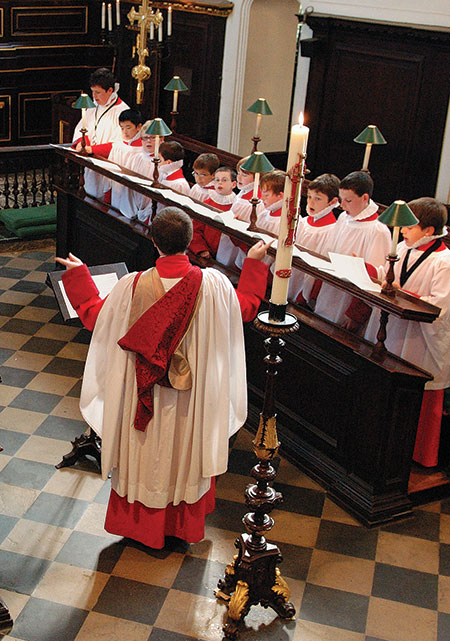
[ABOVE: Boy Choir of All Saints’ Church, Northampton, 7 August 2008—[CC0 1.0] Wikimedia Commons]
Christian History: What do you think is the essence of Anglicanism?
Michael Matlock: The core of Anglicanism is its commitment to the via media (middle way) that seeks to hold together continuity with the historic Catholic tradition and reformational theological insights. Anglicanism values the interplay of Scripture, tradition, and reason in discerning the faith. It has retained a historic episcopal structure and a rich liturgical life centered on the BCP. At its best, it forms Christians through the Daily Office and sacraments, offering a distinctly English vision of worship.
Elise Johnstone: A communal relationship with God, centered in liturgical worship shaped by ancient tradition, the richness and depth of Scripture, and the Spirit-guided discernment through reason. Our deepening relationship with God empowers us to love our neighbors as ourselves.
Bruce Cory: If we mean by “essence” the “distinctiveness” of Anglicanism, I would look to the unique character of the English branch of Catholic/Western Christianity. This character includes elements of pre-Roman Christianity, some of the Roman character contributed by those after Augustine of Canterbury, and elements of the continental reforms. This is accomplished by faithfulness to the prayer-book tradition. We agree to worship together using the words of the BCP. While the prayer book and the Bible provide a textual basis for our common life, we allow a broad range of interpretations and expressions of that textual basis.
Matthew Barrett: Participation is at its heart. Christ assumed our human nature so we can become partakers of the divine nature (2 Pet. 1:4). To that end worship is sacramental. At baptism the priest touches the water as God sanctifies it so the baptized are cleansed from sin and born again (BCP). The Eucharist is a participation in the body and blood of Christ, a communion with his real presence (1 Cor. 10:16). As for worship, in Morning and Evening Prayer, we participate in the communion of the saints—on earth and in heaven. Catholicity is not a church’s autonomous preference but rooted in apostolic succession. With the Council of Nicaea, we confess the creed each Sunday, convinced that bishops and ecumenical councils are essential to preserve the one holy catholic and apostolic church.
CH: How do you see this lived out in your parish?
MB: In a most refreshing way! I’ve launched Anselm House at St. Aidan’s Anglican Church. Anselm Fellows gather for Evening Prayer, the formation of virtue, and friendship over a meal, followed by contemplating God with a text from the Great Tradition. Fellows apply classical theology by participating in the liturgy at St. Aidan’s where they saturate themselves in the Daily Office and sanctify time according to the gospel rhythm of the liturgical calendar.
EJ: Each Sunday we gather and hear the Word proclaimed, and we are strengthened and renewed through the sacrament of the body and blood of Christ. We are empowered to live more fully into being that which we have received: we are inspired to see more fully that we (and all) are God’s beloved. The Holy Eucharist shapes our hearts and minds, and that shaping guides us to flourish in respecting the dignity of every human being—especially through meeting Jesus in our neighbors who are unhoused or underresourced. At St. John the Baptist, Seattle, where I am blessed to serve, we deliver lunches to our unhoused neighbors in encampments in the area, and we support a tiny home village both with meals and in other ways. We have been deepening connections and relationships through a Kenyan parishioner in partnering with scholarships with school children in Kenya.
BC: My church is in the Appalachian Mountains, which have a strong Baptist/congregational presence. Many of the members of St. John’s are former Baptists, Pentecostals, or from other denominations. Very few are “cradle Episcopalians.” Even I have Pentecostal and Roman Catholic roots. We have a member of the Seventh-day Adventist Church who will join us for worship, as well as someone from the nearby Presbyterian church who joins us for Bible study on Sunday mornings before he goes to the Presbyterian church for the worship service. (They have a choir. We don’t.) We come together in this community because we can pray together from the BCP and delve into the Scriptures while also respecting cultural and theological diversity. There is room within the prayer-book tradition for adapting the liturgy into particular contexts. We approach the Scriptures from our unique perspectives, and each perspective is respected, even if not all will agree.
CH: How would you describe your own theological commitments among the many ways Anglicans have identified over the centuries?
BC: My theological commitment is first to the person of Jesus Christ. All other elements—liturgical styles, governance structures, and even many theological differences—are less important. We have one member of the congregation who also regularly attends a nearby Pentecostal church. They sometimes give her a hard time for attending our Episcopal church. We don’t. I often find myself commenting, “Yes, but it is all still Jesus.” I return frequently to a quote sometimes attributed to St. Vincent of Lerins: “In essentials unity. In non-essentials, liberty. In all things, charity.” The essential is Jesus Christ. Everything else is commentary.
MM: I had long identified as an Anglo-Catholic; my theological heart beats with the Caroline Divines and the Oxford Movement. I believe that the church is a visible, sacramental society and that the Eucharist is the center of the Christian life. This commitment to the “Great Tradition” and the visible unity of the church eventually led me to find the fullness of these convictions in communion with the See of Peter [the Roman Catholic Church], much like St. John Henry Newman. My “Anglicanism” was always a desire for the “One, Holy, Catholic, and Apostolic Church.”
EJ: Lex orandi, lex credendi—as some would phrase it, “praying shapes believing.”… As a child and teen, I was primarily formed in the liturgy of Rite I (more Elizabethan in language and theology) and then experienced the breadth of the 1979 BCP, and supplementary liturgical resources of The Episcopal Church as a young adult. This, I believe, has brought me to a more incarnational understanding of our sacramental life, grounded in God’s grace, which I find incredibly loving and humbling. The baptismal ecclesiology, and the eucharistic theology of the current Book of Common Prayer is foundational for me.
CH: How does the liturgy shape your own life and your ministry?
EJ: The Daily Office—reminding me each day, through the Apostles’ Creed and Scripture, of my baptism, and God’s empowering and loving grace—as well as the (at least) weekly celebration of the Holy Eucharist, guides me to empower the community I am blessed to serve. I seek to deepen our communal relationship with God and each other, and this gives me the gift of seeing the face of God in all.
MM: Liturgy is not merely a “style” of worship; it is the lex orandi (law of prayer) that establishes the lex credendi (law of belief). I see the liturgy as the Bible “in motion.” It forms us not according to personal preference but according to the faith of the church. Now, as director of liturgy at the cathedral parish, my ministry is to ensure that the beauty of the Roman Rite draws others into the mystery of Christ, just as the Anglican liturgy once prepared my own heart for this homecoming.
BC: Calling to mind Sacrosanctum Concilium from the Second Vatican Council, the liturgy, for me, is the font and summit of the church. The liturgy is the structure in which we receive the sacraments, the means of grace poured out on us as followers of Christ. The liturgy also serves as the context in which we, as a community, offer our worship to God.
MB: It’s changed my life. I left the Southern Baptist Convention (SBC) to become Anglican and participate in a liturgy whose worship is catholic. My family could no longer survive without a tradition that is defined by the creeds and a church accountable to the councils that gave us those creeds. We were also starving for a biblical tradition that believes the sacraments are sacraments. We found a tradition with a prayer book that reads the Scriptures sacramentally like the Fathers. Liturgy is not a moment during devotions or at church; it shapes my whole life now. CH
By Michael Matlock, Elise Johnstone, Matthew Barrett, Bruce Cory
[Christian History originally published this article in Christian History Issue #160.0 in 2026]
Michael Matlock served as a Protestant professor of Christian Scripture for 25 years, including eight as an Anglican priest. Today he serves as the director of liturgy at the Cathedral of Christ the King in Lexington, Kentucky, and is utilizing the Pastoral Provision to transition toward ordination as a Roman Catholic priest. The Reverend Canon Elise B. Johnstone is rector of St. John the Baptist Episcopal Church (TEC) in Seattle, Washington. The Reverend Bruce W. Cory is a priest in the Episcopal Diocese of Lexington and serves at St. John’s Episcopal Church (TEC) in Corbin, Kentucky. Matthew Barrett is a member of the ACNA, research professor of theology at Trinity Anglican Seminary, theologian-in-residence at Anselm House, host of the Credo podcast, and director of the Center for Classical Theology.Next articles


Recommended resources: Anglicans
Discover the history of the Anglicans—in England, the United States, and worldwide—with these resources recommended by our editors and authors.
the editoris
Questions for reflection: Anglicans
Use these questions to help guide your understanding of the Anglican story.
the editors