Faith holds (very) wide the door


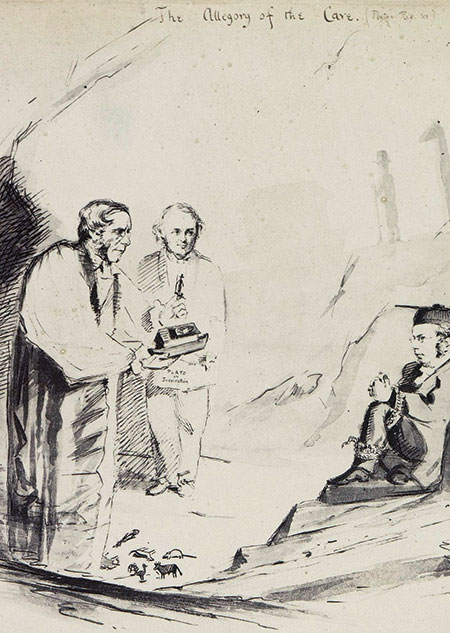
(ABOVE: Fotoreproductie van een tekening, voorstellende John Colenso, professor Jowett en professor Mansel in de allegorie van de grot, 1855/1866—Public domain, Rijkmuseum RP-F-2001-7-23-12)
Interpret the Scripture like any other book.” With this one sentence, Benjamin Jowett (1817–1893), a deacon in the Church of England and the master of Balliol College, Oxford, shook a country and a church.
Jowett wrote this in an essay on the interpretation of Scripture in the popular and controversial Essays and Reviews (1860) produced by seven liberal clergy of the Church of England in response to contemporary controversies, chiefly over Darwinian evolution and higher criticism of the Bible. While Jowett’s essay caused the biggest stir (despite following up his statement with the note that “There are many respects in which Scripture is unlike any other book; these will appear in the results of such an interpretation”), the essay collection as a whole produced a great deal of consternation and an (unsuccessful) heresy trial for several authors.
HIGH, LOW, OR BROAD?
The term “broad church” was first used in an 1850 article by priest and historian A. P. Stanley (1815–1881) who called the English church “not High or Low, but broad.” Essays and Reviews, however, helped crystallize the movement. A growing number of clergy and leaders did not accept Anglo-Catholic or evangelical answers to the era’s intellectual challenges and social problems. In many ways they were heirs of the latitudinarians (see pp. 15–17). Besides Jowett and Stanley, other English churchmen commonly associated with the movement in England were Thomas Arnold (1795–1842) and F. D. Maurice (1805–1872).
While early leaders of the movement hoped this truly broad church would in fact encompass everyone, it soon became clear that this was simply another kind of churchmanship to go alongside high (Anglo-Catholic) and low (evangelical). Broad church adherents wanted a tradition more concerned with social justice and less individualistic than the low church, less ecclesiastical and ritualistic than the high church, and open to using reason to ascertain religious truth instead of exclusive reliance on Scripture and church tradition.
Broad church ideas crossed the Atlantic and penetrated profoundly into Episcopal Church leadership and denominational ethos, primarily through Phillips Brooks (1835–1893), rector of Trinity Church Boston, a well-known writer, and a spellbinding preacher. He was one of the main organizers of the Church Congress movement (1874–1934), which attempted to bring all three church parties—high, low, and broad—into a forum where they could discuss issues together. (A similar movement had begun in England in 1861 and is still ongoing.)
The Church Congress eventually faltered when it became clear during the fundamentalist-modernist controversy of the 1920s that most clergy participants sided with the modernists, upsetting a portion of the Episcopal laity. More successful was broad church involvement in the idea of Episcopalianism as America’s true national church (seen, for example, in the Washington National Cathedral, still an active Episcopal parish).
Today the modern Episcopal Church is largely either high or broad, but not low; evangelicals typically are a part of the REC (Reformed Episcopal Church) or the Anglican Church of North America (ACNA), formed in the 2000s (see pp. 1, 2). All three groups remain living and active in the Church of England, though, as well as around the globe. In 2024 two broad church COE authors, Theo Hobson and Sam Rylands, wrote to the Church Times:
Broad Anglicanism rests on theological ground; for, if God reveals himself in Jesus Christ, Christian speech about God and the world begins by trying to hold in tension two apparent opposites: Creator and creation: Jesus Christ—fully human, fully God, held together in this person found in cradle and cross.
Whether Jowett would have agreed is unknown. Brooks might have, though—the man who wrote in a little-sung verse of his carol “O Little Town of Bethlehem,”
Where Charity stands watching,
And Faith holds wide the door,
The dark night wakes, the glory breaks,
And Christmas comes once more.
By Jennifer Woodruff Tait
[Christian History originally published this article in Christian History Issue #160.0 in 2026]
Jennifer Woodruff Tait, senior editor and issue advisorNext articles
To the ends of the earth and back again
How Anglican missionaries spread the Gospel both near and far
Jonathan S. Riches
No poet is an island
Some writers whose Anglican faith was central to their work
Karen Swallow Prior

Preaching, writing, caring, transforming
Faces of Anglicanism in the twenty-first century
Jennifer A. Boardman