The archbishop’s hand


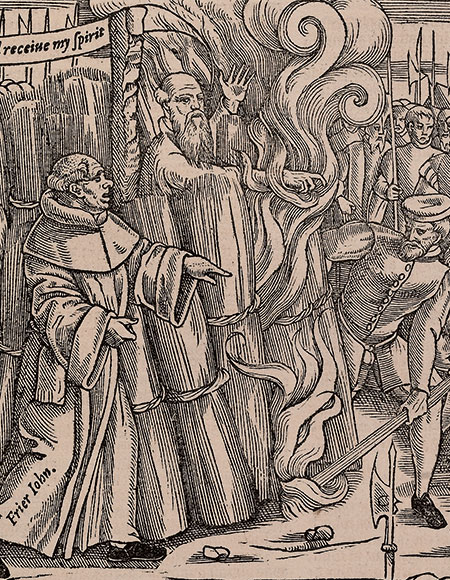
(detail from The burnying of the Archbishop of Caunterbury Doctor Thomas Cranmer in the Towneditch of Oxforde, with his hand first thrust into the fire. From John Foxe, Actes and monuments (Bodleian Library F 3.2 Th.)—© Bodleian Libraries, University of Oxford / [CC BY-NC 4.0] Digital Bodleian)
The pyre was lit. The wood kindled. The chained victim—the defrocked and degraded archbishop of Canterbury, formerly the foremost clergyman in the realm—awaited a slow and painful death by burning in March 1556. Suddenly he stretched forth his right hand, plunging it into the fire and holding it steady among the flames. This was a political and prophetic act, understood as repentance and resistance: penance for signing recantations of his Protestant teaching. It was also a vindication of his previous writing—similarly composed with this hand—especially the Book of Common Prayer. This act punctuated a life shaped by sixteenth-century reform.
UNCONVENTIONAL CRANMER
Who was this individual of confession, conviction, and contradiction? Thomas Cranmer was the first archbishop of Canterbury to embrace the Reformation. Born in Nottinghamshire during the first years of the Tudor dynasty, he spent a third of his life (from his midteens to his forties) ensconced in the scholarly world of the University of Cambridge. Little evidence exists from this period of the dynamic thinking and eloquence that characterized his later theology. However, he gave at least one clear indication that he was unconventional: he married a woman named Joan (who died together with their child in childbirth), an act that delayed him receiving his bachelor of arts and rendered him ineligible for college fellowships and ecclesiastical orders. Only after her death was he ordained a deacon and priest and made a fellow of Jesus College.
Cranmer’s practical counsel for the king propelled him beyond the university and into the orbit of royal service: instead of pursuing a legal case in Rome, Cranmer proposed that Henry VIII and the team advocating for his annulment from Katherine of Aragon should solicit opinions from universities across Europe. He was soon drafting arguments in defense of this aim and serving as a royal diplomat in Germany and Italy. It was on one such mission that he received the startling news that he was to be the next archbishop of Canterbury.
This choice surprised his contemporaries and likely troubled Cranmer; he had just married Margaret—a niece of Nuremberg reformer Andreas Osiander (1498–1552)—in disregard for his vow of celibacy and to the distaste of his monarch, who disapproved of clerical marriage. As archbishop, Cranmer pressed for further religious reform, always in perilous conversation with the royal will: sometimes succeeding, at other times failing to achieve his goals.
ENDURING WORDS
That he survived Henry’s reign meant that Cranmer became one of the chief architects of the religious reform enacted in the name of his son, Edward VI. It also allowed him to produce his greatest and most enduring achievement: the Book of Common Prayer, a reformed English liturgy, which was released in 1549 and revised in 1552. This text—which introduced phrases like “dearly beloved, we are gathered here today” and “ashes to ashes, dust to dust”—is the beating heart of Anglican worship. Moreover, its somber yet stunning prose skillfully captures the theology of conversion and confession that shaped the life and death of its author.
Consider, for example, the evocative language of the General Confession that first appeared in the revised prayer book of 1552:
Almighty and most merciful father, we have erred and strayed from thy ways, like lost sheep. We have followed too much the devices and desires of our own hearts. We have offended against thy holy laws. We have left undone those things which we ought to have done, and we have done those things which we ought not to have done, and there is no health in us: but thou, O Lord, have mercy upon us miserable offenders. Spare thou them, O God, which confess their faults. Restore thou them that are penitent, according to thy promises declared unto mankind, in Christ Jesus our Lord. And grant, O most merciful father, for his sake, that we may hereafter live a godly, righteous, and sober life, to the glory of thy holy name. Amen.
By Jonathan Reimer
[Christian History originally published this article in Christian History Issue #160.0 in 2026]
Jonathan Reimer, associate professor and John H. Van Gorden Chair in History, Eastern UniversityNext articles

Making England good again
The Clapham Sect: Anglican activists of the late eighteenth and early nineteenth centuries
Karen Swallow Prior