Letters to the editor


ALWAYS MORE TO TELL
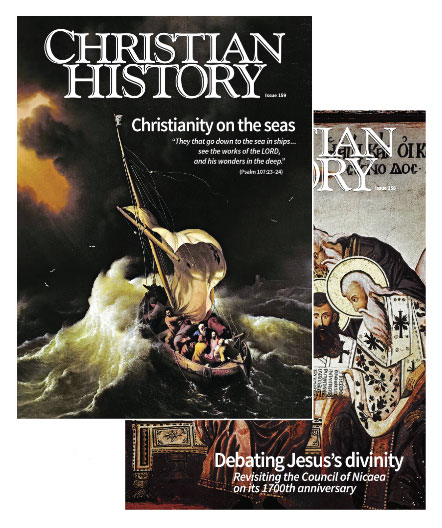
I loved the latest issue, “Christianity on the seas.” When I first saw the title, what came to mind was none of the topics you covered. I first thought about the lyrics from Gordon Lightfoot’s classic “The Wreck of the Edmund Fitzgerald” (maritime themes in pop culture). . . . I would have also liked greater mention of Mercy Ships. Completely missing were topics close to my heart due to the legacy of my parents: Rivers of the World and Seafaring Cowboys. Rivers of the World grew out of the need for the Presbyterian Church in the Congo to transport missionaries to the region. . . .
Perhaps a topic for the future might be how missionaries transitioned during times of crisis, i.e., the Congo revolution. I suspect that virtually every mission organization has historical record of how their missionaries survived and escaped.—Royce Buller, Wesley Chapel, FL
Thanks for sharing, Royce. Choosing which sea stories to cover and which to leave out was a real challenge. Like you mentioned, we could have said a lot more—we hope we’ll return to related topics in the future.
I’ve just finished reading your latest issue of Christian History (159) from cover to cover, as I have done for every one of your issues since issue 1. I am thankful to you for how your work has educated and enlightened me. I write to offer a couple of suggestions for future issues:
(1) The latest issue mentioning Robert Jermain Thomas (CH #159, p. 45) reminds me of the enviable strength of the Korean church. I believe that Korea has one of the greatest percentages of Christians of any country (at least in Asia), and I would love to see an issue on the church in Korea.
(2) Being of Chinese ancestry, I would love to see an issue on John Sung, who is often called the Billy Graham of China. More generally, an issue about Christianity in China would be most welcome.—David Yee, Cary, NC
These are great suggestions. While we have not done a full issue on John Sung, you can find articles about him in issues #98 and #153. We will spend more time with the church of the East soon with an issue on Christianity along the Silk Road in 2027!
Thank you for your moving and informative accounts of seafaring Christianity. Readers may be interested to know that, in the single New Testament passage that identifies “leadership” as a spiritual gift (1 Corinthians 12:28), the apostle Paul uses a nautical term. The Greek word kubernesis means “to pilot a ship;” in the Septuagint (the early Greek translation of the Old Testament), it is used to translate “guidance” in Proverbs 1:5; 11:14; 24:6. On a larger ship, the pilot or steersman might not issue many orders (a separate officer, the keleustes, commanded the rowers), but navigated using the steering oars. . . . There are many rowers who must work together in rhythm, but only one pilot; James 3:4–5 warns us against trying to become our own pilots, setting a different course, by wielding the steering paddles of our tongues.
As I ply my oar, or help to raise a sail, it is encouraging to know that we have a Pilot steering the church who knows the way, never sleeps, adapts to changing conditions, and has a sure and steady hand.—John Espy, Lawrence, KS
CREED REFLECTIONS
When CH posted Jennifer Woodruff Tait’s reflection, “Really God, really human,” from issue #158 on Facebook, we got many comments from readers. Here are just a few.
I have always thought of the Nicene Creed as the expanded version [of the Apostles’ Creed]. They are of course totally in agreement but the Nicene adds detail. I memorized the Apostles’ Creed some 50 years ago. I read the Nicene Creed a dozen times per year. I take great comfort in that no matter what institutions organized by men do, the creeds are still the distilled expression of our faith.—Ed Litteral, South Webster, OH
A profession of our faith that does not include anything about Jesus’s life/mission. As my seminary professor taught, it is a theo-political statement. Constantine wanted to tamp down the discussion, the various thoughts, disagreements about Jesus. If there had been more bishops in attendance who believed as Arius believed, we might have something a little different. . . . Therefore, we must ask (those who are willing) what was the agenda?—Gayle Fisher-Stewart, online reader
I belonged to a United Methodist church that included among its members Al Agnew, one of the last POWs to be released from Vietnam. It was an honor to hear his personal testimony and how he had resisted learning the Scriptures, hymns, and creeds while growing up. Yet while being tortured, he was as surprised as his tormentors when asked, again, “What do you believe?” He responded, “I BELIEVE IN GOD, THE FATHER ALMIGHTY, . . .” and he realized that he actually did.—Marsha Stewart, Madison, IN CH
By Editors and readers
[Christian History originally published this article in Christian History Issue #160.0 in 2026]
Next articles
The Anglicans: Senior editor's note
I was seeking a deeper connection with my Lord at his Supper.
Jennifer Woodruff Tait