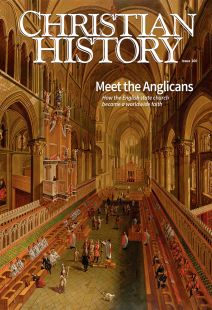
The Anglicans: Senior editor's note


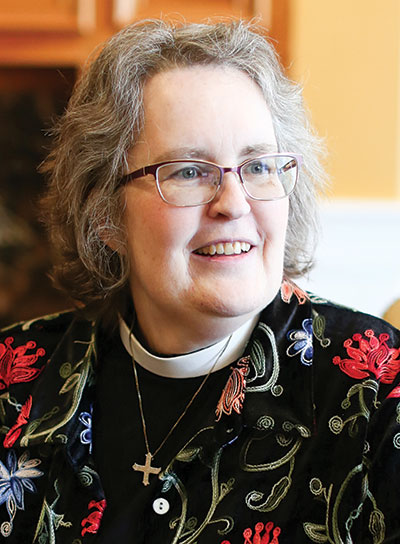
(ABOVE: Jennifer Woodruff Tait, 2026)
The story of this issue for me starts 32 years ago. When I was in seminary to become a Methodist preacher, two things happened at once.
One is that I was in a class on the history of Christian worship. I learned for the first time that the early Christians had celebrated the Eucharist on every Lord’s Day and that John and Charles Wesley had received the Eucharist as often as they could. (John Wesley wrote a sermon about this: it’s called “The Duty of Constant Communion,” and you can find it online.)
The second is that I was just finishing my supervised ministry internship at a Methodist church in the area, and it was common for interns not to keep attending the church where they had interned. I needed to find somewhere else to go. It just so happened that I had recently been to a choral concert at the big old Gothic-and-stained-glass Episcopal cathedral downtown.
I thought I might go back on a Sunday morning— knowing, in the back of my head, that Anglicans of all sorts generally celebrated the Eucharist weekly. I was seeking a deeper connection with my Lord at his Supper. I went that Sunday morning, and I stayed for the next two years.
ANGLICAN OUTSIDER
There is not enough space here for me to tell you the whole story of how I eventually joined the Episcopal Church in 2011 and became a priest in 2016—step by step following the leading of Jesus and where he seemed to want me to serve him. But I tell this part of the story here because it affects my advisory guidance over this issue on the history of Anglicanism in two ways.
The first is that I came to Anglicanism as an outsider, as no doubt are many readers of this issue. You’ll soon learn—if you didn’t already from our “Did you know?” feature on the inside front cover—that Anglicans have specialized terms for most aspects of church life. Some terms trace all the way back to the early church and some arose in the Middle Ages or later. Anglicans also have ways of organizing themselves that may seem odd to Christians used to nondenomi-
national churches.
As we walk through the Anglican story together, we hope that this issue will help explain and demystify Anglican ways of being Christian. This includes what it means to be a state church and what happens when you stop being one; the ways Anglicans can look and sound “Catholic lite” (and why they do); the pervasive influence of Anglicanism on Western culture and the Book of Common Prayer on Western literature; the global journey of an expression of Christian faith that was once explicitly and particularly English; and the debates that have shaped and fractured the movement.
The second is that, as I say in “Generations upon generations” (pp. 29–32), nobody is neutral about the Episcopal Church—especially, I would argue, in the last half century and particularly in the last 23 years (see pp. 48–49 for more on why). Because we were well aware of this, we have sought to tell the story of that fraught recent history with fairness and candor, inviting many different perspectives into the telling.
Everybody stands somewhere when they look at history, after all. Jesus has called me to stand here. Whatever your own Christian tradition, listen for where he is calling you. CH
By Jennifer Woodruff Tait
[Christian History originally published this article in Christian History Issue #160.0 in 2026]
Next articles