Hearts strangely warmed


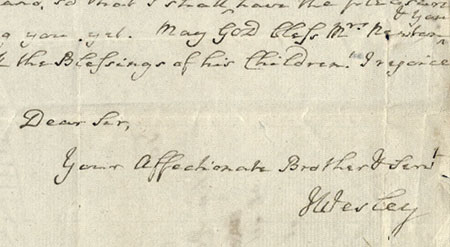
(ABOVE: John Wesley, autographed letter to John Newton, Norwich (Last known letter to John Newton), 25 February 1767 (original holograph), pp. 1 & 4—Public domain, Osborn Manuscript Files, Box 163, File 15904; Beinecke Rare Book and Manuscript Library; Yale University, 16839225)
Like so many others in the eighteenth century, John Newton and John Wesley joined the transatlantic movement we now call the Evangelical Revival (or more often in the States, the Great Awakening). Beginning with rumblings in Central Europe that spread Pietists and their “heart religion” to places from Siberia to North Carolina, this movement ignited a renewed passion for “experiential religion” even as it took on various contours of Christian expression found in its path.
In England the revival started in the 1720s , combining with a recovery movement that stemmed from the “recent unpleasantness” of the previous century (see pp. 15–17), the dormant piety of Puritan forebears, and the holy living tradition of high church Anglicanism. Early on figures such as John and Charles Wesley, Howell Harris, George Whitefield, and others were swept up in this movement, eventually spending the rest of their lives trying to keep up with it.
AWAKENED ANGLICANS
Key to the movement was an emphasis on a conversion experience or even an “awakening.” Some, such as the Wesley brothers, came from solid Christian backgrounds and had a Christian faith already. Others like Newton left rebellious lifestyles.
Wesley’s Aldersgate experience in 1738 carried him into evangelicalism when he felt his “heart strangely warmed.” A decade later Newton’s awakening took place while he was steering a ship caught in a great storm, on a date that he would commemorate the rest of his life—March 21. (To the consternation of later evangelical abolitionists, Newton would captain three slave ships following this experience. His abolitionist fervor came later.)
The subjective nature of these experiences led not only to a cottage industry of printed testimonials, but to very different theological approaches to salvation itself. Newton and Wesley represent well the two dominant theological trajectories of the revival in Anglican circles, one distinctly Reformed (Newton) and the other grounded in the high church (Wesley).
Both Newton and Wesley were priests of the Church of England, even if Newton was brought up in dissent (see p. 28). After captaining slave ships and working as a tide surveyor, Newton’s ministry was “regular,” with incumbencies in Olney and in London. Wesley’s ministry started at Oxford as a Fellow but was later marked by “irregularity,” an itinerant ministry with an emerging network of societies and lay preachers that created a unique subculture within the church.
LOVE IN TENSION
The men knew each other, having met in 1757. Their differing theological trajectories caused tension. In Wesley’s last known letter to Newton in 1767, Wesley refused to take part in any further disagreement, but he added toward the end of the letter:
Certainly I believe some of your opinions to be just as wrong as you believe mine to be. But this does not prevent my loving you; yea, and seriously thinking you are much holier than me.
He closed the letter with “Your affectionate brother and servant.” Wesley lived until 1791, and out of his ministry arose worldwide Methodism. Newton lived until 1807 and became a mainstay of evangelical Anglican thought in the centuries that followed.
Christian History has written much on both John Wesley and John Newton: see issues #2, #69, and #81 for more.
By Ryan Danker
[Christian History originally published this article in Christian History Issue #160.0 in 2026]
Ryan Danker, director of the John Wesley InstituteNext articles

“The sacred gift has been handed down”
Tracts for the Times was a series of 90 essays published between 1833 and 1841 by members of the Oxford Movement in the Church of England. Below are some excerpts that show their desire to move Anglican doctrine and practice closer to a Catholic model.
tractarians
Christian History Timeline: The story of Anglicanism
Highlights of events covered in this issue
the editors
“Reformation without tarrying”
Dissenters from the Church of England founded parallel religious communities
Edwin Woodruff Tait