Christian History Timeline: The story of Anglicanism


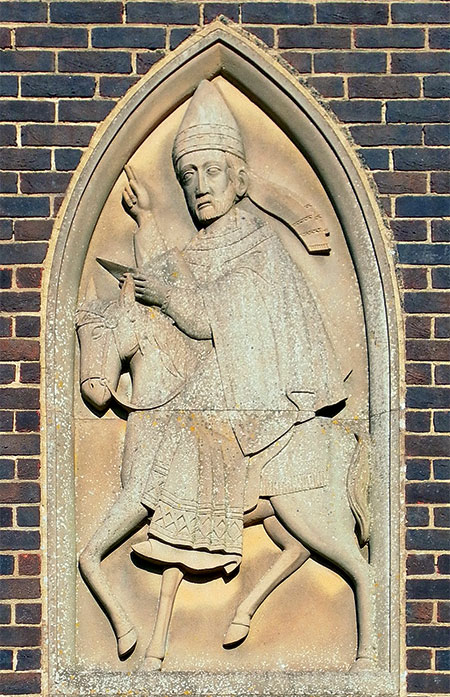
(ABOVE: Menter33 (poster), Theodore of Tarsus, Archbishop of Canterbury, unspecified Catholic Church, Crawley, West Sussex, UK (bas relief)—Reddit)
— c. 47 The Roman Empire gains control over southeastern Britain. Christianity is well established by the fourth century.
— 304 Alban is martyred in London.
— c. 389 Patrick is born in Roman Britain. As a teen he is enslaved in Ireland. Years later he returns to evangelize the island.
— 563 An Irish Christian community sends Columba to Iona (modern-day Scotland) to establish a monastery.
— 596 Pope Gregory sends Roman prior Augustine to England. Augustine becomes the first archbishop of Canterbury.
— 793 Norsemen attack Lindisfarne Priory, beginning a series of conquests on English coasts.
— c. 1078 Anselm, archbishop of Canterbury, writes Proslogion. Anselm helps solidify greater ecclesiastical control in the church in England.
— 1131 England establishes its own monastic order, the Gilbertines.
— 1138 A time of widespread lawlessness, known as the “Anarchy,” begins.
— 1164 King Henry II establishes the Constitutions of Clarendon.
— 1170 After being exiled for refusing to sign the Constitutions, Archbishop Thomas Becket returns to Canterbury. Four knights murder Becket after his continuing conflict with Henry II.
— 1215 Archbishop Stephen Langton drafts the Magna Carta.
— 1372 John Wycliffe begins translating the Latin Vulgate Bible into Middle English.
— 1415 The Council of Constance posthumously declares Wycliffe a heretic.
— 1509 Henry VIII’s reign begins in England.
— 1533 Thomas Cranmer becomes archbishop of Canterbury.
— 1534 The Act of Supremacy declares Henry VIII the supreme head of the English church, initiating the Protestant Reformation in England.
— 1547 Edward VI succeeds Henry VIII as king and initiates further reform.
— 1549 The first edition of the Book of Common Prayer (BCP) is published.
— 1552 The BCP is revised, continuing reforms to the Church of England.
— 1553 Edward dies. Catholic Mary becomes queen, reverses reform, and persecutes Protestants.
— 1556 Cranmer is burned as a heretic.
— 1558 Mary dies and Elizabeth’s reign begins. She reinstates the BCP and returns the country to Protestantism.
— 1603 James ascends to the English throne. A year later he enforces church conformity, resulting in the ejection of Puritan clergy from the church.
— 1607 Anglicans establish the first English-speaking colony in the New World in Jamestown, Virginia.
— 1615 Poet John Donne becomes a priest in the Church of England.
— 1625 Charles I becomes king of England.
— 1633 Poet and Anglican clergyman George Herbert publishes The Temple.
— 1637 Charles attempts to force the English BCP in Scotland. The Covenanter movement and the Bishops’ Wars follow.
— 1642 Religious conflict escalates into the English Civil War, largely between royalists and parliamentarians.
— 1649 Charles I is executed.
— 1653 Oliver Cromwell becomes lord protector of England.
— 1656 Parliamentarians gain victory and ban the Church of England (COE), resulting in sporadic persecution of clergy and laity involved in traditional services.
— 1658 Cromwell dies, likely of sepsis.
— 1660 Charles II assumes the English throne, beginning the Restoration. The Declaration of Breda promises toleration of all religious factions in England.
— 1661 The Cavalier Parliament, made up mostly of royalists, is elected, leading to persecution of nonconformists.
— 1662 Parliament ejects dissenting ministers. The revised BCP is released.
— 1685 James II’s reign begins. His leniency toward Catholics and dissenters breeds resentment, and he is deposed in 1688.
— 1713 Satirist Jonathan Swift appointed dean of Dublin’s St. Patrick’s Cathedral.
— 1738 John Wesley has his Aldersgate experience. George Whitefield arrives in the American colonies to preach for the first time. Satirist Laurence Sterne is ordained in the COE.
— 1748 John Newton cries out to God during a sea storm.
— 1757 Newton and Wesley meet.
— 1780 William Wilberforce enters Parliament at age 21.
— 1784 Methodists organize in the new United States as a denomination separate from Anglicanism. In England they will separate in 1803.
— 1784 Samuel Seabury secures consecration from the Scottish Episcopal Church to serve as a bishop in the United States.
— 1785 The first General Convention of The Protestant Episcopal Church in the United States of America (later the Episcopal Church or TEC) is held.
— 1787 Wilberforce joins the abolitionist movement against the slave trade.
— 1789 The Protestant Episcopal Church ratifies a new prayer book and officially declares itself separate from the COE.
— 1792 Evangelical preacher John Venn begins his tenure at Holy Trinity Church in Clapham, where Wilberforce lives. The Clapham Sect coalesces with key members to reform society.
— 1804 Absalom Jones is ordained as the first Black priest in the Episcopal Church.
— 1817 Bishop John Henry Hobart founds the Episcopal Church’s first seminary, General Theological Seminary, in New York.
— 1822 The British Navy liberates the slave ship holding Samuel Ajayi Crowther.
— 1823 The more evangelical Protestant Episcopal Seminary of Virginia is founded.
— 1825 Crowther becomes a Christian in Sierra Leone and trains for the ministry.
— c. 1830 Episcopalians send missionaries abroad.
— 1833 The Emancipation Act frees enslaved people across the British Empire. John Henry Newman and others begin writing and publishing Tracts for Our Times, advocating for Anglo-Catholic reform in what became known as the “Oxford Movement.”
— 1847 Charlotte Bronte publishes Jane Eyre
— 1850 The term “broad church” is first used by A. P. Stanley to describe the ideal English church.
— 1860 The controversial Essays and Reviews is published by seven liberal clergy in the Church of England.
— 1864 Crowther is named “Bishop of the countries of West Africa.”
— 1871 Missionary Bishop John Coleridge Patteson is martyred at Nukapu Island in the South Pacific.
— 1872 Anglican Christina Rossetti writes the beloved devotional poem, “In the Bleak Midwinter.”
— 1873 The evangelical-leaning Reformed Episcopal Church (REC) forms in response to theological differences within the Episcopal Church.
— 1927 Modernist poet T. S. Eliot joins the Church of England.
— 1931 C. S. Lewis is convinced of Christianity and returns to the COE.
— 1938 Anglican author Dorothy Sayers writes Are Women Human?
— 1974 The “Philadelphia Eleven” are ordained irregularly, the first female priests in TEC.
— 1976 The General Convention of TEC regularizes the ordination of women and develops a new prayer book in light of Vatican II insights.
— 1979 The new BCP for TEC is published.
— 1998 Conservative bishops from the worldwide Anglican Communion attend the Lambeth Conference to oppose support of homosexual relationships. They are instrumental in passing the Lambeth 1:10 Resolution.
— 2000 Churches in Africa and South America establish the Anglican Mission in the Americas. They establish multiple mission organizations over the next two decades.
— 2008 Nigerian bishop Peter Akinola and Uganda Bishop Henry Orombi are instrumental in the establishment of the Global Anglican Future Conference (GAFCON).
— 2009 The Anglican Church of North America is formed in response to the consecration of Gene Robinson as a TEC bishop.
— 2026 Sarah Mullaly is consecrated as the first woman archbishop of Canterbury.
By the editors
[Christian History originally published this article in Christian History Issue #160.0 in 2026]
Next articles
“Reformation without tarrying”
Dissenters from the Church of England founded parallel religious communities
Edwin Woodruff Tait
Generations upon generations
From a single settlement to a national power: the Episcopal Church in America
Jennifer Woodruff Tait

To the ends of the earth and back again
How Anglican missionaries spread the Gospel both near and far
Jonathan S. Riches