“The sacred gift has been handed down”


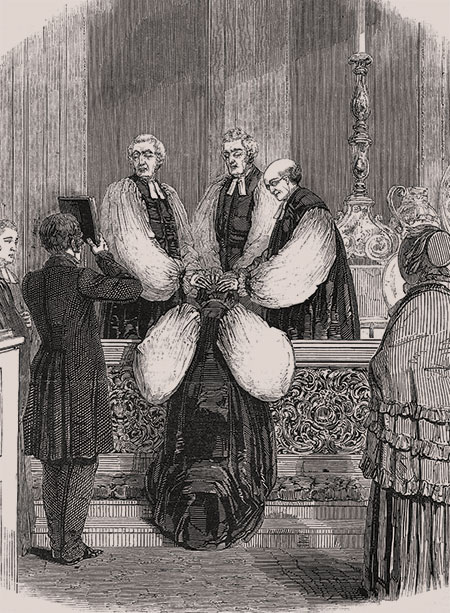
(ABOVE: Consecration of a bishop, at Whitehall Chapel, The illustrated London news 10, no. 246 (16 January 1847): 41—Public domain / HathiTrust)
There are some who rest their divine mission on their own unsupported assertion; others, who rest it upon their popularity; others, on their success; and others, who rest it upon their temporal distinctions. This last case has, perhaps, been too much our [i.e., the Church of England clergy’s] own; I fear we have neglected the real ground on which our authority is built, OUR APOSTOLICAL DESCENT. We have been born, not of blood, nor of the will of the flesh, nor of the will of man, but of GOD. The LORD JESUS CHRIST gave His SPIRIT to His Apostles; they in turn laid their hands on those who should succeed them; and these again on others; and so the sacred gift has been handed down to our present Bishops, who have appointed us as their assistants, and in some sense representatives.
—Tract 1, “Thoughts on the Ministerial Commission” (John Henry Newman)
Here we see the common course of things in the world. We omit a duty. In consequence our services become inconsistent. Instead of retracing our steps we alter the Service. What is this but, as it were, to sin upon principle? While we keep to our principles, our sins are inconsistencies; at length, sensitive of the absurdity which inconsistency involves, we accommodate our professions to our practice. This is ever the way of the world; but it should not be the way of the Church.
—Tract 3, “On Alterations in the Liturgy” (Newman)
If we take the example of the holy men of Scripture as our guide, certain bodily privation and chastisement are a very essential duty to all who wish to serve GOD, and prepare themselves for his presence.
—Tract 21, “Mortification of the Flesh a Scripture Duty” (Newman)
The oftener we do it [partake of the Lord’s Supper], the more expert we shall be at it, and the more benefit and comfort we shall receive from it. It is very difficult, if not impossible, for those who do it only now and then, (as once or twice a year,) ever to do it as they ought; for every time they come to it, they must begin as it were again; all the impressions which were made upon their minds at the last Sacrament, being worn out before the next; and it being a thing they are not accustomed to, they are as much to seek how to do it now, as if they had never done it before. It is by frequent acts that habits are produced. It is by often eating and drinking this spiritual food, that we learn how to do it, so as to digest and convert it into proper nourishment for our souls.
—Tract 26, “The Necessity and Advantage of Frequent Communion” (excerpt from a sermon by Bishop William Beveridge, 1637–1708)
Rites and ordinances, far from being unmeaning, are in their nature capable of impressing our memories and imaginations with the great revealed verities; far from being superstitious, are expressly sanctioned in Scripture as to their principle, and delivered to the Church in their form by tradition.
—Tract 34, “Rites and Customs of the Church” (Newman)
It was easy for those, free from the errors of Rome, to see that her doctrine of the sacrifice interfered with that of the one Sacrifice on the Cross; but many overlooked that the belief in that Sacrifice might then only be altogether sound, when the Eucharistic Sacrifice was also reverenced.
—Tract 81, “Catena Patrem” (Edward Pusey)
It may be objected that the tenor of the above explanations is anti-Protestant, whereas it is notorious that the Articles were drawn up by Protestants, and intended for the establishment of Protestantism; accordingly, that it is an evasion of their meaning to give them any other than a Protestant drift, possible as it may be to do so grammatically, or in each separate part. . . . In the first place, it is a duty which we owe both to the Catholic Church and to our own, to take our reformed confessions in the most Catholic sense they will admit; we have no duties toward their framers. . . . In giving the Articles a Catholic interpretation, we bring them into harmony with the Book of Common Prayer, an object of the most serious moment in those who have given their assent to both formularies.
—Tract 90, “Remarks on Certain Passages in the 39 Articles” (Newman)
By tractarians
[Christian History originally published this article in Christian History Issue #160.0 in 2026]
Next articles
Christian History Timeline: The story of Anglicanism
Highlights of events covered in this issue
the editors
“Reformation without tarrying”
Dissenters from the Church of England founded parallel religious communities
Edwin Woodruff Tait
Generations upon generations
From a single settlement to a national power: the Episcopal Church in America
Jennifer Woodruff Tait