

When God Moved, the Jordans’ TROUBLES Turned to Triumph


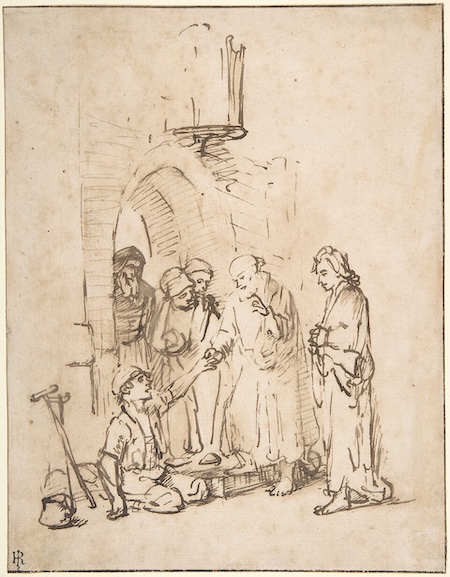
(ABOVE: Rembrandt van Rijn, St. Peter and St John Healing the Paralytic (drawing)—Metropolitan Museum of Art / [CC0 1.0] Wikimedia)
WHEN JAMES R. JORDAN DIED in 1882 at the ripe age of eighty-four, he left behind two sickly daughters, a grandson, and a barely-mobile widow whose broken hip bones had healed out of alignment. The family were faithful members of Chicago’s Lincoln Park Congregational Church. Their support came through the small wages of the two daughters, Mrs. H. J. Furlong and Addie S. Jordan.
During the latter part of 1882, Addie was Mr. Jordan’s caregiver, leaving Mrs. Furlong to handle their business alone. The stressful situation brought partial paralysis on Furlong. One of her feet dragged and one of her hands became almost useless. Meanwhile, Addie had been battling consumption (tuberculosis) for years and her condition worsened while she tended their father.
One evening Mrs. Furlong sat at the table alone and depressed. She had considered an electric treatment but skipped two appointments with the doctor. As she pondered her plight, she thought of Christ and the miracles he worked. With her good hand, she stretched the paralyzed hand on the table and asked, “Dear Lord, will you heal me?”
Like an electric shock, the life began to move in her arm, and the continued sensation was as though something that, previously, had not moved was set in motion. The feeling passed up to the head, and down the body to the foot. She was healed! And she was grateful! She did not speak of her experience to the family, but retired. She rose early the next morning, and awoke her son—a prayerful, dutiful young man—and said to him, “I’m going to church, today.” He replied, “Then I’ll get up and go with you,” expecting that she must ride.
Her soul was solemnly full that day of the felt presence of the Holy Spirit, and she did not like to talk. Her son watched her movements, astonished.
She went to the church, took a class again in Sunday School, and, in going back and forth to church that day and evening, walked about sixty blocks without weariness.
Mrs. Furlong became convinced the Lord also wanted to heal her sister, whom the doctors said was beyond hope. Addie, however, became worse. She reached a point she couldn’t even take her medicine. Mrs. Furlong went in to give it to her, but instead asked her if she would like to throw the ineffectual potion away—and did.
Six hours of united waiting upon the Lord followed. They were hours of pain. From nine in the morning till three in the afternoon, she suffered indescribable pain. A few minutes after three, the pain left her, and with a bright look, she said, “I believe I’m better.” She wanted to rise and dress, but Mrs. Furlong advised her to rest through the night. She said she had not, in five years, been so free from weariness and pain.
Miss Jordan lay on the lounge most of the time for two days. One of her expressions was, “It’s perfect bliss to lie here free from pain.” Her breathing became perfectly natural, and very soon the great hollow place in the upper part of the chest, over the left lung, filled out. Shortly before her healing, she only weighed eighty pounds; but a few months after her weight had increased to one hundred and twenty pounds.
Addie recovered quickly, although her cough hung on for several months. She eventually became a missionary to freedmen in the South.
During this time Mrs. Jordan (the impaired widow) broke her left wrist. At her age, the shock left her enfeebled. Her eyes, ears, and brain were failing. She felt useless, unable even to read her Bible or remember whom she attempted to lift up in prayer. Nonetheless a neighbor with infirmities of her own declared, “When I’m hungry for a blessing, I go down to see old lady Jordan.”
In answer to prayer, Addie received a strong assurance that her mother would also be healed. On this day, 16 June 1884, she reminded the Lord of his promise to make the blind see, the lame walk, and the deaf hear. The next morning the two daughters and grandson watched to see the old woman’s movements. Seeing she could walk without her cane,
they gathered around her and said, “Are you not healed, mother?” and she began to think she was, and sat down in her chair by the table. Could she move her hand? The doubled-up thumb and straight, stiff finger were perfectly free and as limber as ever, and the stiff wrist joint moved with perfect freedom! She heard as well as anybody! Could she see? She went upstairs to her Bible, whose blurred, dim pages she had thought closed to her forever, and she could read as well as ever, and without glasses! She could thread the finest needle. Could she kneel and thank the Lord? She had not knelt for eight years. Yes, she could kneel as well as when she served the Lord in her youth!
Afterwards Mrs. Jordan walked five blocks to church and could take the stairs as well as anyone.
Emeline Dryer, who worked with Moody to found the Moody Bible Institute (see our Dryer story on 5 February) knew the Jacobs for thirteen years and testified of their faith and the truth of this series of divine interventions.
—Dan Graves
CH 142, Touching the hem of his garment, is entirely devoted to divine healing
Other Events on this Day
- Booth and Mumford Partnered for the Gospel
- HOW JOHN HENRY NEWMAN BECAME ONE OF ENGLAND’S MOST FAMOUS CATHOLICS