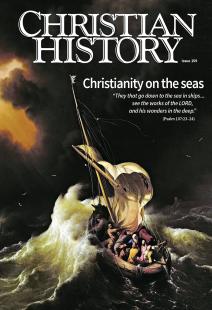
Letters to the editor: Christianity on the Seas


HISTORY TO EXPLORE
Please seriously consider doing a full issue on A. W. Tozer. This generation needs to hear again the voice of God’s prophets. Thank you for reminding us of the Council of Nicaea in your last issue. How Tozer delighted in the God-enamoured saints of the early church. Athanasius will always be remembered for his sterling courage in the midst of such brutal opposition. Tozer also needs again to be remembered for his steadfast devotion to the Lord Jesus Christ. He also gave prominence to the deity of Christ, and his rightful place in the consciousness of his beloved Church needs emphasis once again.—Michael Carlascio, Sault Ste Marie, Ontario, Canada
I am appreciative of your magazine and just discovered that I can read back issues! I was looking through past issues to see if I could find one on the history of the theology and celebration of the Eucharist. With an awakened interest in church history and as a Protestant I have become very interested in learning the history around the Eucharist and how the early church viewed it, the church fathers, Catholic and Eastern Orthodox and Protestant development. Perhaps it would be too controversial, but still, there is a history there to be explored! Did I miss an issue on this topic or would it be a possibility for the future?—Jeanie Little, Houghton, NY
We always appreciate suggestions for topics, even if we’ve covered them before. In the meantime, for a few entry points into the story see our issues #37: Worship in the early church; #54: Eastern Orthodoxy; and #115: Luther leads the way.
COUNCILS AND CREEDS
Even though this letter is somewhat delayed, I wanted to make time to write and express gratitude for your last issue #157 Vatican II. I have only subscribed to Christian History for a short period of time, but in that period I have been enormously pleased by just about every issue—even those religious or spiritual areas of modest interest. While I converted to the Orthodox Catholic Church from Roman Catholicism at an early age, I have not been one to turn my back on the church of my youth but instead have always endeavored to find ways to bridge our sister churches that include our “separated brethren” of Protestant Christianity. This issue dedicated to Vatican II has helped me in that spiritual venture in many unexpected ways, and I am so very thankful. Kudos! I am now holding you to a higher bar: you have given me a joyful expectation that your magazine will never disappoint me.—Christian Williams, Coalinga, CA
I am neither a scholar nor a theologian, just a reader and thinker. Thank you so much for the comprehensive coverage of the development of the Nicene Creed in issue #158. I find the congregational recitation of the creed a meaningful part of worship. I am acutely aware that as we recite “God of God, light of light . . . being of the same substance with the Father” the man standing next to me and I probably have differing mental images of how that all works; and yet we are both Christians saved by grace. In fact, I must maintain my humility to acknowledge that my brother’s image might be closer than mine to the truth. Creeds, like maps, are useful man-made tools to assist our understanding...
I find great comfort in the story of Jesus being crucified between two unnamed thieves. When the one thief admitted that he deserved punishment due to his deeds and stated that Jesus had done nothing wrong, Jesus took that as a confession and statement of belief. Then the request, “Jesus, remember me when you come into your kingdom.” Jesus did not inquire about his understanding of the Trinity nor of the rapture. He simply promised, “This day you will be with me in paradise.” I’m counting on that.—Bill Buhro, Lincoln, NE
The last two issues in particular have been just terrific. They both took areas that had always seemed murky to me—the Vatican Councils and the creedal disputes of the 300s–400s (what was all the fuss about, why did it matter to people, what went on inside?)—and made them clear and relevant! Each article was illuminating.—Randy Welch, Arvada, CO
GETTING OUR DATES RIGHT
First, thank you to all the staff and writers of your wonderful magazine. It has greatly helped my faith and I enjoy being able to share helpful tidbits of church history in my small group Bible study. I believe I have found a minor error in the latest issue (also in issue #85 since it is a reprint article). On page 18, in the second sentence: “...Eastern church insisted it had to be on the date of Jesus’s resurrection—Nisan 14, the Jewish Passover.”
Nisan 14 was the date of Jesus’s crucifixion, not his resurrection. The East prioritized remembering Jesus as the perfect lamb slain for us and thus kept the date on Passover.
—Jesse Hendrix, Long Beach, CA
You are correct, Nisan 14 is traditionally considered the day of Jesus’s crucifixion, which our Fasts and Feasts guide explains in “Celebrating the Risen Savior” on p. 33. Our digital issues of #85 and #158 have been corrected accordingly. CH
By Our readers and editors
[Christian History originally published this article in Christian History Issue #159.0 in 2026]
Next articles
Editor's Note: Christianity on the Seas
Sea stories and the dynamics of life at sea hold endless dramatic possibilities.
Kaylena Radcliff
The sacramental sea
Scripture often alludes to the ocean
Writers of the Bible as translated by the English Standard Version