The sacramental sea


(ABOVE: Jonah Cast into the Sea—Unknown engraver, 1873 / public domain, Wikimedia)
Scripture often alludes to the ocean—whether in figurative language describing God’s creation of and sovereignty over it or in narrative that displays his power and purposes. Here are just a few excerpts.
CREATOR AND KING OF WATERS
The earth was without form and void, and darkness was over the face of the deep. And the Spirit of God was hovering over the face of the waters. (Gen. 1:2)
Mightier than the thunders of many waters, mightier than the waves of the sea, the LORD on high is mighty! (Ps. 93:4)
The sea is his, for he made it, and his hands formed the dry land. (Ps. 95:5)
When you pass through the waters, I will be with you; and through the rivers, they shall not overwhelm you. (Isa. 43:2a)
I placed the sand as the boundary for the sea, a perpetual barrier that it cannot pass; though the waves toss, they cannot prevail; though they roar, they cannot pass over it. (Jer. 5:22b)
HIS WONDERS IN THE DEEP
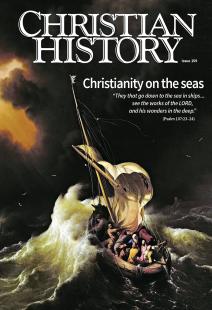
Many psalms reference the sea. Psalm 107 has long been used in prayer by and for seafarers:
Some went down to the sea in ships
and plied their trade in deep waters;
They beheld the works of the LORD
and his wonders in the deep.
Then he spoke, and a stormy wind arose,
which tossed high the waves of the sea.
They mounted up to the heavens
and fell back to the depths;
their hearts melted because of their peril.
They reeled and staggered like drunkards
and were at their wits’ end.
Then they cried to the LORD in their trouble,
and he delivered them from their distress.
He stilled the storm to a whisper
and quieted the waves of the sea.
Then were they glad because of the calm,
and he brought them to the harbor they were
bound for.
Let them give thanks to the LORD for his mercy
and the wonders he does for his children. (Ps. 107:23–31)
Jonah, seeking to escape God’s command to preach to the Ninevites, flees by sea in the opposite direction. In response God causes a great storm to threaten his ship. The terrified pagan sailors onboard discover the storm arose because of Jonah’s disobedience. Jonah proclaims they can only save themselves by casting him into the sea. When they finally throw Jonah overboard, the storm immediately ceases; in their terror and awe they sacrifice to the LORD. Meanwhile a great fish swallows Jonah. After three days and nights inside, Jonah prays:
I called out to the LORD, out of my distress,
And he answered me;
Out of the belly of Sheol I cried,
And you heard my voice.
For you cast me into the deep, into the heart of the seas,
And the flood surrounded me;
All your breakers and waves passed over me.
Then I said, “I am driven from your sight;
Yet I shall again look upon your holy temple.”
The waters closed in over me to take my life;
The deep surrounded me.…
Yet you brought up my life from the pit,
O LORD my God. . . .
And the LORD spoke to the fish, and it vomited Jonah out upon the dry land. (Jon. 2:1–6; 10)
When Job questions God’s purposes after suffering great calamity, the LORD answers by questioning Job instead:
Who shut in the sea with doors
when it burst out from the womb,
when I made clouds its garment and thick darkness its
swaddling band,
and prescribed limits for it and set bars and doors,
and said, “Thus far shall you come, and no farther,
and here shall your proud waves be stayed?”
. . . . Have you entered into the springs of the sea,
or walked in the recesses of the deep?” (Job 38:8–11; 16)
JESUS CALMS THE STORM
And when he got into the boat, his disciples followed him. And behold, there arose a great storm on the sea, so that the boat was being swamped by the waves; but he was asleep. And they went and woke him, saying, “Save us, Lord; we are perishing.” And he said to them, “Why are you afraid, O you of little faith?” Then he rose and rebuked the winds and the seas, and there was a great calm. And the men marveled, saying, “What sort of man is this, that even the winds and seas obey him?” (Matt. 8:23–27)
SHIPWRECKED, BUT SAVED
But soon a tempestuous wind, called the northeaster, struck down from the land. And when the ship was caught and could not face the wind, we gave way to it and were driven along. . . . Since we were violently storm-tossed, they began the next day to jettison the cargo. And on the third day they threw the ship’s tackle overboard with their hands. When neither sun nor stars appeared for many days, and no small tempest lay on us, all hope of our being saved was at last abandoned.
Since they had been without food for a long time, Paul stood up among them and said, “Men, you should have listened to me and not have set sail from Crete and incurred this injury and loss. Yet now I urge you to take heart, for there will be no loss of life among you, but only of the ship. For this very night there stood before me an angel of the God to whom I belong and whom I worship, and he said, ‘Do not be afraid, Paul; you must stand before Caesar. And behold, God has granted you all those who sail with you.’ So take heart, men, for I have faith in God that it will be exactly as I have been told. . . .”
But striking a reef, they ran the vessel aground. The bow stuck and remained immovable, and the stern was being broken up by the surf. The soldiers’ plan was to kill the prisoners, lest any should swim away and escape. But the centurion, wishing to save Paul, kept them from carrying out their plan. He ordered those who could swim to jump overboard first and make for land, and the rest on planks or on pieces of the ship. And so it was that all were brought safely to land. (Acts 27:14–25; 41–44) CH
Scripture from the ESV copyright © 2001 by Crossway Bibles, a publishing ministry of Good News Publishers.
By Writers of the Bible as translated by the English Standard Version
[Christian History originally published this article in Christian History Issue #159.0 in 2026]
ESV copyright © 2001 by Crossway Bibles, a publishing ministry of Good News Publishers.Next articles