

Sauñe Gave His Life BLOOD to Win Peru for Christ


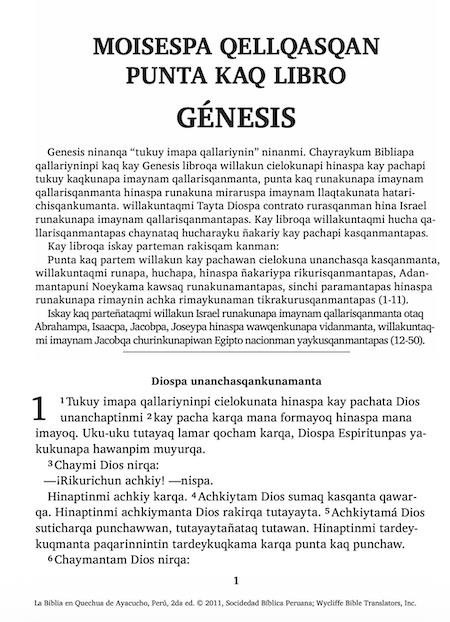
(ABOVE: Genesis 1 in the Ayacucho Quechua language. © 2011 Sociedad Bíblica Peruana; Wycliffe Bible Translators)
ON TUESDAY, 8 SEPTEMBER 1992, a procession of two thousand people marched across Ayacucho, Peru, to a cemetery. In their hands they lofted Quechua-language Bibles or placards saying, “Ayacucho for Christ.” The Bibles they lifted were the work of the man whose memory they honored; “Ayacucho for Christ” had been his slogan. Finding the cemetery locked while the caretakers lunched, the mourners sang hymns—many of them written by the same man—and some testified about his love.
Rómulo Sauñe was the grandson of Pastor Justiniano who planted the first evangelical church in nearby Cakiqpampa. Sauñe was a bright and promising student until a horse kicked him in the head. Afterward he had great difficulty learning. He had to retake first grade twice. Other children called him Opa—stupid one.
Despite his slow start, he would become one of the best-educated men in the region and co-translator of the Bible into the local Quechua language. He had a knack for expressing God’s word in the idioms of his people. While training in the United States, he married Donna Jackson, an American who had served in Peru. Two of their children (Kusi and Tawa) became workers with the Runa Simi mission that Sauñe helped found in 1983. Another child (Quni) became a medical doctor and the fourth (Romi) a lawyer.
Sauñe strove for effective outreach in Ayacucho Province. Translating the Bible into Quechua and training people to read it was of first importance. So hungry were Quechua Christians for God’s word that the first printing of twenty thousand Bibles proved insufficient. Twenty thousand additional copies had to be ordered at once. Mission leaders were incredulous, but Sauñe had known all along how it would be. People sold their outer garments to raise enough money to buy one of the precious books, setting a sales record for the Peruvian Bible Society.
Among other tools he used to spread the gospel and strengthen the church were banners, unity services, and evangelistic meetings. One of his innovations was to set hymns in traditional Quechua five-note forms. At first he and his collaborators met fierce opposition from Western-trained ministers, who considered the ancient musical style demonic. The common people, however—especially youth—loved the cultural tonalities. Eventually Quechua churches accepted the traditional sound.
A Marxist movement named the Shining Path (Sendero Luminoso) terrorized the Peruvian highlands. Government forces battled to control them. Christians who opposed violence—such as Sauñe and his grandparents—were hated by both the military and the terrorists.
Twice the home of Justiano and Teofila (his grandparents) was burned to the ground. Police abused the elderly Teofila, accusing her of sympathy with the Shining Path. Not to be outdone, the Shining Path tortured Justiano and killed him in imitation of ancient Incan sacrifices. The military forced Teofila to dig up his body unassisted as they watched, to verify that he was indeed dead.
Amid such terror, Sauñe never quit. His abilities and efforts did not go unnoticed by international Christians. On this day, 23 June 1992, in Manila, the World Evangelical Fellowship awarded him its first-ever Religious Liberty Award. Dressed in traditional Quechua garb, he accepted the award in the name of the Quechua people.
His success as an evangelist and in getting peasants to cooperate for the common good made him a target of the Shining Path. Following his return to Peru from Manila, terrorists made several failed attempts on his life. But on 5 September 1992, he was caught at a Shining Path roadblock. The terrorists killed several victims in cold blood. Among them was Sauñe. “We got him!” they exulted over two-way radio. Minutes later a military helicopter appeared overhead and shot Sauñe’s killer. About a week later, the Marxist professor who founded and fostered the Shining Path was captured by government forces and sentenced to life in prison.
—Dan Graves
CH 109 Eyewitness to modern persecution has more about Sauñe along with many other modern martyrs.
Other Events on this Day
- Etheldreda's Desire to Be a Nun Led to the Founding of Ely
- MARK OF EPHESUS STOOD ALONE FOR ORTHODOXY