John Noble CLUNG to Faith In Soviet Prisons


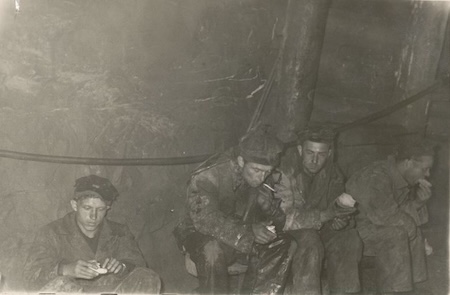
(ABOVE: Political prisoners on a break inside a mine in Dzhezkazgan (Джезказган), part of the Soviet Gulag system. Second from left is Lithuanian Justinas Lebedžinskas (arrested in 1946 and sentenced to 10 years of hard labor).—Lietuvos integrali muziejų informacinė sistema; Kauno IX forto muziejus / Kaunas 9th Fort Museum / [CC BY 4.0] Wikimedia)
DO OUR SUFFERINGS HAVE PURPOSE? John Noble had reason to thank God for his. Noble’s American family lived in Germany during World War II. Unharmed during the bombing of Dresden in 1945, they remained after the war to operate their camera-making business. The Soviets arrested John and his dad. Held in Dresden’s Miinchenerplatz prison, the two were among twenty-three prisoners who survived systematic starvation. Seven hundred died around them. He credited Christ.
On the sixth day of a twelve-day starvation period, he reached a point of weakness in which he told the Lord he could not go on any longer. He pleaded with God to take him or else give him strength to go on. New strength flowed into him. “Literally, I felt as though I was born again.” It was then that he committed his life to Christ.
Cruelty was nonstop. As a clerk of prison records, he knew so many details that he feared the Soviets would never dare release him because he could testify about their atrocities.
During ten long years of captivity, harrowing experiences, and slave labor in numerous prisons, his faith deepened. At Muhlberg, doctor-prisoners took out his appendix using kitchen knives and bent can lids as clamps. Transferred to Buchenwald he saw planes flying the Berlin airlift. At Buchenwald he saw “the gray of prison routine give way to something brighter” at Easter and Christmas when prisoners were allowed religious services. He also found a purpose for survival there—knowledge that he must live to tell the world of Soviet atrocities. “I knew I was observing things that must be reported to the free world when I was given freedom.”
At Erfurt we were herded into the basement of a large commandeered house. We slept on straw-filled bags tossed on the basement floor. “Outside, an organ grinder played the same anguishing tune over and over: ‘Komm zurtick’ (Come back).”
From there he was transferred to Weimar, where sentences were handed out. “There almost seemed to be no life. Prisoners stared blankly at the newcomers. No one spoke.” Interrogated on this day, 13 March 1950, he was sentenced to fifteen years of physical labor, but was not told on what charges. His next stop, Berlin’s Lichtenberg, was a bedlam of terrible noises as new prisoners were tortured. He was held there a week and not once was there a silent moment. “We found no rest by night or day.”
Voloda was the worst stop: “The cells were underground, there were more rats than prisoners, and claustrophobia ruled.” While prisoners tried to sleep, rats walked across their faces. Although the prisoners did not have enough to eat themselves, they fed the voracious rodents at the edge of the room to keep them at bay.
His final destination was the coal mines of Vorkuta, where temperatures averaged about -60º and dipped to -90º. Among his harrowing tasks was hand-setting rail car switches. He had to hold each switch shut by hand as he crouched between moving cars and the wall, yank his hand out just before a wheel rolled over it, then grab the switch again for each of thirty wheels. If he were not to move his hand in time it would be crushed or severed; if he did not set the switch quickly enough the cars would derail and crush his body. He did that job for six months.
His father was released in 1952 and moved to Detroit where his story prompted a small Christian and Missionary Alliance church to pray for Noble’s release. Meanwhile Noble managed to get a message to a relative in Germany. President Eisenhower used that information to personally pressure the Soviet Union for Noble’s release. Two years after the Alliance church began praying, its prayers were answered. After his release, Noble wrote I Was a Slave in Russia and I Found God in Soviet Russia. The latter sold tens of thousands of copies and reported many instances of heroic, suffering faith and miraculous deliverance for himself and other Christians in those terrible prison camps.
After years of petitions and court proceedings, Noble recovered his family’s company and castle from the former East Germany. He died in 2007.
—Dan Graves
A story with similarities from Rumania is told in Bless You Prison