John Wise Advocated Personal and Congregational Freedoms


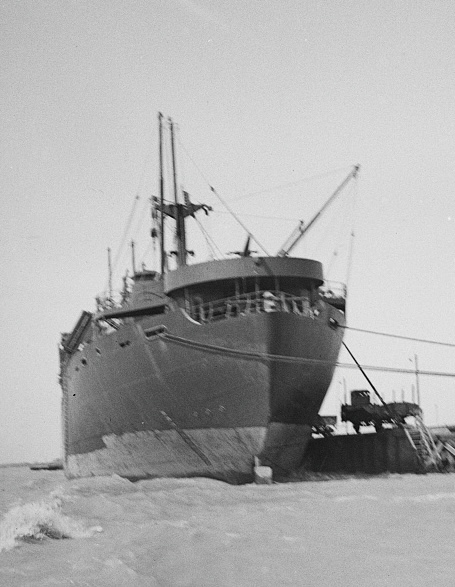
(ABOVE: A Liberty Ship docked in Russia. Public domain, Library of Congress.)
JOHN WISE was a church leader and advocate for freedom. Educated at Roxbury Latin School, he went on to Harvard where he graduated in 1673 at the age of twenty-one. He then began studying for the ministry. Ordained on this day, 12 August 1663, after a few short pastorates, he was installed as minister at Chebacco in Ipswich county on this day, 12 August 1663. He held the position for the remainder of his life.
A rugged individual, Wise served as chaplain for two armed expeditions, one against Indians, the other against Quebec. He farmed. A credible legend circulated during his lifetime that while serving as pastor of Chebacco, Wise wrestled John Chandler of Andover and beat him in two bouts, throwing him over a stone wall in the second. Chandler is supposed to have dusted himself off and said that if Wise would just throw his horse over the wall to him, he’d be on his way.
In 1687 Governor Andros imposed taxes without the consent of Massachusetts leaders. John Wise was spokesman for a group who refused to pay. His resistance melted when he faced severe consequences. He apologized, did a few days in prison, paid a heavy fine, and was deposed from ministry temporarily. Had he held out he could have expected to serve months in prison as did Major Samuel Appleton who refused to apologize to the governor or to admit any wrongdoing.
Later Wise wrote in defense of the independence of church congregations when some leaders (such as the Mathers) sought to reduce the power of the laity in churches. He noted that the New Testament letters were written to autonomous churches; that each man stands or falls before God as an individual and therefore ought to have a say in his church; that God gave men dignity so that, even in saving them, he turns their wills rather than forcing them.
His conclusion was that congregationalism was the biblical mode of church organization. “If we find that the primitive churches, in their order and discipline, did exactly agree in the essentials of government with the churches in New England, we may rationally then conclude that if they were apostolical, so are we.” However, Wise’s Vindication of congregationalism examined only the Scriptures that supported his position and did not explain passages that do not, such as Paul’s instruction to Titus to appoint elders in Crete.
Wise considered Jesus the ultimate source of all authentic power and authority. “Democracy is Christ’s government in church and in state,” he wrote. He saw the Lord as the sine qua non of gospel preaching, paraphrasing Paul “If Christ be preached, whether in pretense, or in truth, either by old or by young, yet therein we do rejoice…”
His writings are credited with influencing the Declaration of Independence. In 1942 the US Navy launched a liberty ship named after him.
—Dan Graves
For more about the struggle for freedom in America, see CH 50 The American Revolution