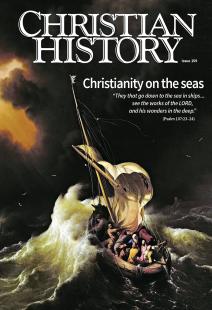
Tempestuous voyages


(ABOVE: Ship Caravan on which the Judsons and Newells sailed from Salem, Mass., 1812, n.d. (halftone photomechanical print)—Courtesy of the Trustees of the Haverhill Public Library, Special Collections Department)
FIRST CENTURY: PAUL WITNESSES TO THE GOSPEL DURING A SHIPWRECK
The greatest danger of winter sailing, of course, was shipwreck. In his second letter to Corinth, Paul mentions being shipwrecked three times and on one of these occasions, spending a night and a day floating in the open sea. Yet we know of another shipwreck still, and Luke’s description of it in Acts 27 (see pp. 6–7) is one of the most vivid narratives in all of ancient literature. At Caesarea Paul was placed on board a ship from Adramyttium; at Myra, in southern Turkey, he was transferred to an Alexandrian grain ship headed to Rome. Luke’s reference to the Day of Atonement (about October 5) indicates that this ship was sailing late in the season.
After reaching the southern coast of Crete, the captain wished to get to the larger harbor at Phoenix to winter, but a ferocious northeaster, the Euroclydon, cast the ship helplessly adrift westward for many days without sight of sun or stars. The ship took such a battering it had to be abandoned. Ancient ships carried small boats for the transfer of passengers to the shore but no life rafts or life vests. It was miraculous that all 276 passengers and crew survived. Paul and the others found themselves shipwrecked at Malta, where they were forced to stay for three months.
—Edwin M. Yamauchi, originally published in #47
EARLY SIXTH CENTURY: BRENDAN THE NAVIGATOR FINDS THE PROMISED LAND
The most famous pilgrim of the medieval north was Brendan, the Irish monk who set off in a boat and landed, after years of wandering the seas, on the shores of the “Land of Promise.” Brendan’s trip to the “desert in the ocean” earned him sainthood as well as fame in manuscript versions of his adventures that circulated throughout Europe for centuries.
—Lisa Bitel, originally published in #60
We read that Brendan’s travels, in the company of numerous fellow monks, took him to many earthly and heavenly places, and ultimately to “the Land of Promise.” One account tells us that, as Brendan roamed uncharted seas, he encountered Judas Iscariot, temporarily released from his tortures on Sundays and feast days. Some even wonder if Brendan’s travels took him across the Atlantic to North America. Extravagant as some of these tales are, Brendan’s questing life symbolizes the spiritual yearning for the dwelling place of God.
—Kathleen Mulhern, originally published in #60
1734: CHRISTOPHER WIEGNER, A SCHWENCKFELDER, DEDICATES HIMSELF TO CHRIST
[Wiegner writes:] On the 25th still contrary winds. The waves struck 10 ells over the ship. Because I was not properly lodged, my head became fevered and my thoughts were not able to remain firm, struggle so hard as I might. It finally caused me much sorrow. I remembered how a Christian must conquer all in Christ. I called to him from the heart for strength. In the evening the dear Savior took away the struggle and gave me such peace that I thought of nothing nor knew nothing except my: Lamb and Savior. It was a heavy concern with me to know if it was not my calling to dedicate my life completely to chastity, poverty, and voluntary discipleship and service.
—Excerpt from Wiegner’s diary, originally published in #21
1736: JOHN WESLEY SEES THE FAITH OF THE MORAVIANS
[Wesley writes:] At seven [p.m.] I went to the Germans. I had long before observed the great seriousness of their behavior. . . . There was now an opportunity of trying whether they were delivered from the Spirit of fear, as well as from that of pride, anger, and revenge. In the midst of the psalm wherewith their service began, the sea broke over, split the main-sail in pieces, covered the ship, and poured in between the decks, as if the great deep had already swallowed us up. A terrible screaming began among the English. The Germans calmly sung on. I asked one of them afterwards, “Was you not afraid?” He answered, “I thank God, no.” I asked, “But were not your women and children afraid?” He replied, mildly, “No; our women and children are not afraid to die.” From them I went to their crying, trembling neighbors, and pointed out to them the difference in the hour of trial, between him that feareth God, and him that feareth him not. At twelve the wind fell. This was the most glorious day which I have hitherto seen.
—Excerpt from John Wesley’s published journal, originally published in #1
1748: JOHN NEWTON EXPERIENCES GOD'S MERCY ON A SLAVE SHIP
The Greyhound’s voyage from Brazil to Newfoundland, laden with slaves, led the vessel on March 21, 1748, into a violent storm. In poor repair the ship soon began to split and take on water, and Newton was awakened from sleep to find that a crewmember had been swept away in the raging sea.
“Tied to the ship to prevent being washed away,” relates historian Bruce Hindmarsh, Newton “pumped and bailed all night until he was called upon to steer the ship. All the while he reviewed his life: his former professions of religion, the extraordinary twists of past events, the warnings and deliverances he had met with, his licentious conversation, and his mockery of the Gospels.” At first Newton was convinced that he had sinned too much to have any hope for God’s forgiveness. Yet when the storm did not recede and he really felt he would soon meet his God, he at last clung to Scriptures that taught God’s grace toward sinners, and he breathed his first weak prayer in years. As he was later to recall it, this was “the hour he first believed.”
—Chris Armstrong, originally published in #81
1793: JAMES HALDANE BECOMES CONVINCED OF THE TRUTH OF CHRISTIANITY
[Haldane’s] maritime career spanned eight adventurous years. No adventure may have been more important than one that occurred during a storm. The captain ordered Haldane to let an able seaman (a sailor of lower rank) precede him up the shrouds. That man was struck in the head by loose rigging and plunged to his death in the sea. Had Haldane been the foremost, it might have been him. . . . While lying in harbor, Haldane began to study the Bible. The conviction grew on him that all was not right with his soul. “However dark my mind still was, I have no doubt but that God began a work of grace on my soul while living on board the Melville Castle,” he later wrote.
—Dan Graves, from CHI’s It Happened Today feature
1812: THE JUDSONS AND THE NEWELLS PREPARE FOR NEW LIVES
The discomforts and dangers at sea made the prospects of death very real. Constant or recurring motion sickness, even when the ship was not pitching in a violent storm, left travelers severely weakened and vulnerable to more serious illnesses. The voyage preyed on the weak. Both Ann Judson and Harriet Newell gave birth at sea. Neither child survived. The ship could be both lifeline and coffin. . . .
The most famous occurrence aboard the Caravan—Adoniram Judson’s change of views regarding infant baptism—highlights the importance of shipboard reading. . . . The voyage gave time for lingering doubts about infant baptism to fester into open disbelief on the matter. . . .
Harriet, the first of the earliest American missionaries to die, left perhaps the most fitting epitaph of their life at sea and its lasting effects:
My attachment to the world has greatly lessened, since I left my country, and with it all the honors, pleasures, and riches of life. Yes, mamma, I feel this morning like a pilgrim and a traveler in a dry and thirsty land, where no water is. Heaven is my home; there, I trust, my weary soul will sweetly rest, after a tempestuous voyage across the ocean of life.
—Stephen R. Berry, originally published in #90
1892: D. L. MOODY DECIDES TO CONTINUE HIS WORLD'S FAIR CAMPAIGN
On the second evening of their torturous wait [to be rescued after a shipwreck], Moody led a prayer service that calmed many of the passengers, including himself. Although he was sure of heaven, the thought of his work ending and of never again seeing his family had unsettled him.
One biographer includes another angle to the incident. Prior to the trip, a doctor had found irregularities in Moody’s heart and urged him to ease his schedule; if Moody did not, he would die early. Moody determined to slow down and while sailing homeward, decided to scale down plans for the World’s Fair campaign.
During the crisis at sea, however, Moody perceived that God confronted him with a decision: would Moody press on with all his might to deliver the gospel or would he be cautious, allowing fear to diminish his fervor? Facing death Moody decided that if God would spare his life, he would work with “all the power that He would give me.” And if he should die this year or next, that was in God’s hands.
The following morning, however, the steamer Lake Huron discovered the stranded ship and towed it 1,000 miles to safety. D. L. Moody pressed on with his World’s Fair campaign, six months of unceasing labor, from which, in Moody’s estimate, “millions . . . heard the simple gospel” and “thousands [were] genuinely converted to Christ.” Moody died in the midst of his work—seven years later.
—Vinita Hampton Wright, originally published in #25
Edwin Yamauchi is professor emeritus of history at Miami University. Lisa Bitel is Dean’s Professor of Religion at the University of Southern California. Kathleen Mulhern is a freelance author, scholar, and professor. Chris Armstrong is senior editor of Christian History. Dan Graves authors CHI’s daily stories and does layout for Christian History. Stephen R. Berry is associate professor at Simmons University and author of A Path in the Mighty Waters: Shipboard Life and Atlantic Crossings to the New World. Vinita Hampton Wright is an author and editor retired from Loyola Press.
By various authors
[Christian History originally published this article in Christian History Issue #159.0 in 2026]
Next articles

“For those in peril on the sea”
The official hymn of British and American navies
Jennifer Woodruff Tait
Anchored in Christ
Christian care for seafarers in the nineteenth and twentieth centuries
Jason Zuidema