New Book on "Uncle Bud" Robinson


Jennifer Woodruff Tait reviews Abram Book's latest work
For the past thirty years I have been attending the annual meetings of the Wesleyan Theological Society. This group is open to folks from any and all Wesleyan denominations (as well as fellow-travelers from other churches who are interested in aspects of Wesleyan theology), and thus is responsible for my meeting a large number of Nazarenes, though I have never been a Nazarene myself.
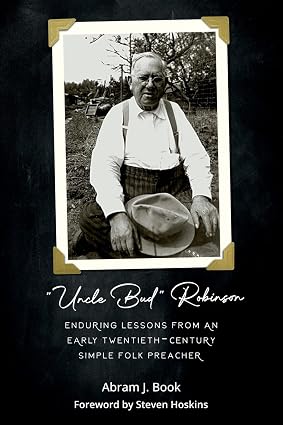
One of the things I noticed when talking to Nazarenes, especially those interested in the history and heritage of the denomination, is that they talked frequently, and fondly, about someone named “Uncle Bud.” Eventually I figured out that they meant traveling evangelist Reuben Robinson (1860-1942; you can read his obituary and see his gravestone here.) Robinson, called “Uncle Bud” by everyone who knew him, began life as the illiterate (and probably epileptic) son of a drunkard in the Tennessee mountains; got converted, joined the Methodist Episcopal Church, South, and learned to read at approximately the same time; got kicked out of the MECS for holiness beliefs and ended up Nazarene; preached over 30,000 sermons; converted tens of thousands of people; published ten books; and embedded himself in the DNA of the Church of the Nazarene for generations. A charitable question might be - how? And why had I never heard of this man?
Abram Book, assistant professor of English & Communication at Southeast Missouri State University, has gone a long way towards answering that question with his new book, “Uncle Bud” Robinson: Enduring Lessons from an Early Twentieth-Century Simple Folk Preacher. While this is not a biography in the traditional sense, Book does outline Uncle Bud’s life and exploits briefly. But Book’s most pressing question is what made the man such an effective communicator–“the Mark Twain of the early twentieth-century holiness movement,” as Book puts it–who was at one point “the most popular man in America.”
Book’s training in communications theory gives him the tools to explore Uncle Bud’s use of narrative, his identification with the audience, his trustworthy presentation, his specific oft-used rhetorical techniques such as expansion and repetition, and his emotional and logical appeals - all of which “modeled robust, innovative Christian thought that could thrive outside of traditional academic and intellectual circles, even and especially amongst the socially and educationally marginalized” and made Uncle Bud “a creative rhetor who masterfully built trust within rhetorical situations” and “a gifted practitioner of what might now be referred to as public relations.”
Also, and helpfully, Book gives the reader the information to watch for these forms of rhetoric - or the lack of them - in modern religious circles, especially within the holiness and evangelical movements. He concludes with lessons we can all learn from Uncle Bud’s career to reflect on our own faith, form and shape our spiritual practices, guide our communities, and unite doctrine with action.
For all those reasons, this book is highly recommended. Plus, it’s just plain fun to hear extensively from Uncle Bud himself throughout. (Who wouldn’t want to read and hear more from a man who once said, “When I was a sinner I lived on bread and molasses; when I got converted the Lord said, ‘your bread and water shall be sure,’ and threw in streaked bacon; but since he sanctified me He sets me in a glass cupboard and pitches red apples at me till I laugh myself to sleep”?) Do check it out.
Jennifer Woodruff Tait is senior editor of Christian History. Find Abram Book's newest book "Uncle Bud" Robinson here, and read Abram Book's article for CH on Uncle Bud here.